Archive for the ‘public’ Category

All that He Is

Saturday, 5 March 2011

Although I'm something of a fan of E[lzie] C[risler] Segar, what I like most when it comes to Popeye are the animated cartoons made by the Fleischer Studios, before they relocated to Florida. (Some years ago, the Woman of Interest got me a copy of Popeye the Sailor: 1933 – 1938, which was exactly the perfect collection for me.)

Anyway, I thought that I'd present my single favorite bit from those cartoons: [animation of Popeye jumping from a stool and beginning to pump his fists] For a better sense of what is happening here, watch Popeye the Sailor Meets Ali Baba's Forty Thieves (1937), or at least the minute and 48 seconds starting at 6:12.

Popeye and Olive and Wimpy are the restaurant of an oasis village, when there is a warning that Abu Hassan and his band of forty thieves are out on a raid. The villagers go into hiding (as does Olive). Indeed, the thieves approach this very village. Popeye hears a great commotion outside, leaps from his stool, and begins pumping his fists.

Popeye the Sailor Meets Ali Baba's Forty Thieves is, over all, not actually my favorite Popeye cartoon — which, off the top of my head, might instead be Popeye the Sailor Meets Sindbad the Sailor (1936), though I'm not sure — but this one bit is perfect. Popeye isn't sure what he's about to confront, but he's prepared to fight it! Popeye is emotionally prepared to fight anything,[1] and he expects to do so with his fists!

Popeye is, in important respects, a simple man. He has many apparently unexamined certitudes, leaps to conclusions, and often does things that are very inappropriate. And he knows that he's simple; that's part of what he's saying with I yam what I yam and that's all what I yam! Popeye doesn't typically think his way out of a problem; it doesn't even seem to occur to him to try. If thinking were suggested to him, then he'd probably confess that he couldn't. He uses his fisks 'cause that's what he's gots. And, ultimately, they've always seemed to be enough.

But, in the moral sphere, he is consistently doing his very best. Not just what others might see as enough, but his best. I yam what I yam and that's all what I yam! isn't used to rationalize shirking. Popeye is prepared to fight whatever comes through that door because, if it's bad, somebody has to fight it; and, if Popeye doesn't fight it, well, then who will?


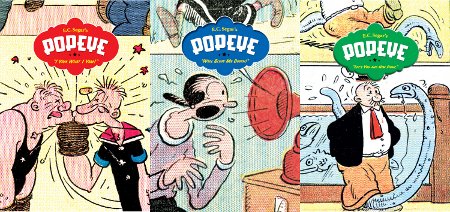
BTW, on Thursday, I received copies of the first three volumes of the Fantagraphics Popeye reprints from Edward R. Hamilton, mentioned in a previous entry; they had no remainder marks. (And the transaction seems otherwise to have been perfectly satisfactory.)


[1] Except in-so-far as he has no personally acceptable means by which to fight a woman.

The Red Death

Sunday, 27 February 2011

Uhm, Firefox programmers? I have a question for you: What does this thing [enlarged image of red button with central 'x' from Navigation Toolbar] actually mean? You know, that red button with the central white x on the Navigation Toolbar. [image of red button on Navigation Toolbar] What's s'posed to happen when I click on it?

Let me explain my question. Traditionally, browsers gave me something like this [image of hexagon] It looks a lot like a stop sign, and clicking on it was a lot like stepping on a brake. The browser stopped what it was doing. That's not exactly what happens when I click on your little red-circle-with-the-eks. Now, it's as if my brakes have been redesigned by a passive-aggressive sociopath. Metaphorically speaking, the car will no longer stop before it goes into the intersection; instead, it will stop either on the other side or just in the intersection.
Really, I mean, when I'd discover that a site was trying to send me some big-ass graphic, I would use the friendly stop-sign button, and it would stop the loading of that thing. The new red button says Just a minute; let me finish loading this big-ass graphic. Or I'd click on a link, and things would churn and churn, so I'd decide to bail. With the stop-sign button, the browser just stopped, leaving me at the prior page on which the link was; with the new red button, it goes to a blank screen (and then, to back-up, Firefox demands that the server of the previous page be re-sent everything to reload the page from scratch, which might not even be directly possible).

Anyway, I'd like either to get the functionality associated with the old button restored, or at least some honest revelation of the functionality associated with this new button. It seems, well, evil.

TNX.

FavIcons, Apple Touch Icons, Site Thumbnail Images, and WordPress

Saturday, 26 February 2011

While someone somewhere has surely written a nice clean, unified explanation on associating favicons, Apple Touch icons, and site thumbnail images with WordPress 'blogs, I've not seen it; and, when it comes to supporting site thumbnail images in WordPress themes, I have seen an awful lot of discussion that is unclear, and PHP code that is inflexible, breakable, or already broken. Perhaps I'm now about to contribute to the problem, but I'm here going to make my own attempt at discussion.

[This entry was written at the suggestion of the Woman of Interest, but she's really not to blame for how it turned-out.]

FavIcons, Apple Touch Icons, and Site Thumbnail Images

First, I'll try to explain the rôles and invocations of these images without peculiar reference to WordPress or to PHP.

Working Code and How to Use It

I think that a great many people are just going to want code that they can drop into a theme, and a practical explanation of how to use that code, so I'll provide such code, with an explanation of how to use it.

PHP and WordPress Coding Issues

A few hardy or lost souls are going to want to know what motivated that code, how it actually does what it does, or what I see might be done differently. (Some of them might do a rather better job than have I.) For those readers, I have prepared a very boring discussion.

A Capitalist Manifesto

Tuesday, 22 February 2011

In a foot-note to a previous entry, I mentioned that, when people use the word capitalism, I want a definition.

The word capitalism, when first introduced, meant a condition of possessing capital, and the coördinate term capitalist identified one who possesses capital.

At some point, a new definition for the former was introduced. The word capitalism was used derogatorially, for a system that favors capitalists. The reason that this definition doesn't much work except for disparagement is that, under any system that has capital, there are capitalists (possessors of capital). For example, a system that declares a present or former proletariat to be the rightful owners (collectively or otherwise) of the means of production has declared them to be the rightful capitalists, and would favor their interests.

(At some further point, capitalist acquired the additional meaning of one who favors capitalism. But, if we replace the definition of capitalist within capitalism to use this later meaning, then we just have an idiotic loop-de-loop, within which capitalism is defined as a system that favors the interests of those who favor the system, which definition wouldn't do much to exclude all sorts of systems.)

In the OED, one finds basically the original two definitions of capitalism:

The condition of possessing capital; the position of a capitalist; a system which favours the existence of capitalists.

But my copy of the New SOED (1993) instead defines the term thus:

The possession of capital or wealth; a system in which private capital or wealth is used in the production or distribution of goods; the dominance of private owners of capital and of production for profit.

It's a bit troublesome to find the historically second definition seemingly shoved-down a memory hole;[1] but, in any case, one now finds two new definitions, one in terms of how capital is used, the second in terms of some sort of dominance by private capitalists, and of production for profit.[2] (That definition in terms of dominance might actually be an attempt to capture the sense of the historically second definition.)

Meanwhile, though, Merriam-Webster had its own thoughts on the subject. They define capitalism as

an economic system characterized by private or corporate ownership of capital goods, by investments that are determined by private decision, and by prices, production, and the distribution of goods that are determined mainly by competition in a free market

Well, it's probably worth noting that free market is a bit of a redundancy, in that, to the extent that prices or quantities are bounded by law, one isn't really talking about a market. But, in any case, the main thing to note is that this definition differs markèdly from the previous definitions, as corporate as well as private[3] ownership is allowed, and as a reliance upon markets has been introduced into the definition.

My 1975 copy of the AHD gives a remarkable definition:

1. An economic system characterized by freedom of the market with increasing concentration of private and corporate ownership of production and distribution means, proportionate to increasing accumulation and reinvestment of profits. 2. A political or social system regarded as being based on this.

That's kind-of like the Merriam-Webster definition, but with a theory of increasing concentration grafted onto it; and, not only increasing concentration, but proportionate increase. Huh. So, in other words, capitalism, at least under the definition labelled 1., refers to a system that not only has never existed, but couldn't ever exist; 'cause, as I guarantee you, economic processes don't typically follow nice lineär laws (nor simple arithmetic functions more generally). And one wonders what one is supposed to call a system in which there is a market, but not increasing concentration of wealth, or at least one in which wealth is not increased proportionately. Really, of course, what's going on with this definition is some attempt to impose a theory and to advance a social prescription.

But wait! My 1993 copy of the AHD tells us something else! It defines capitalism thus:

An economic system in which the means of production and distribution are privately or corporately owned and development is proportionate to the accumulation and reinvestment of profits gained in a free market.

Uhh… it's more of that proportionality stuff; another system that never has and never could exist. But, now, instead of investment increasing concentration of ownership, it's producing growth. Another attempt to grind an ideological axe, just a different axe. (I guess that versions of the AHD are kind-of like versions of Wikipedia, except that the changes are effected more slowly.)

Okay, so that's — what? three? five? — very standard sources, and how many definitions? And what is one to think when someone uses the term state capitalism, and defines it to mean an economy controlled by the state in a capitalist manner?

I once responded to an essay by asking the author what he meant by capitalism. His reply was that he'd used it with the standard definition. Well, there is no standard definition.[4] As far as I'm concerned, the word capitalism is practically useless, unless what one wants to practice is confusion, or unless one defines it before or immediately after first using it.


[1] The SOED is supposed to be complete for terms and definitions found after 1700.

[2] An unclarified notion of profit appears here; there's no point in doing anything under any system, unless it actually improves things somehow; one suspects that the author has some narrower notion in mind.

[3] Some people loosely use the term corporation to refer simply to an association of some sort, but that would be just another sort of private ownership; legal corporations, on the other hand, are creatures of the state. They can be formed by license to a single person, rather than to an association. Corporations are treated by law largely as themselves persons. And they insulate those to whom they are licensed from liability, not merely to those with whom they contract (to whom liability could anyway have been limited by overt contractual terms) but to third parties who may be injured by the actions of the corporation.

[4] I cited some of these dictionary entries to make that point to him, and reïterated my question; he lapsed into silence.

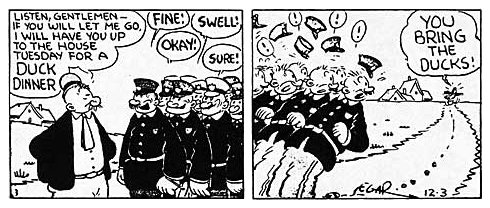
He'll Bring the Books

Monday, 21 February 2011

The first three volumes of the Fantagraphics Popeye reprints are currently available from

Edward R. Hamilton Bookseller Company
PO Box 15
Falls Village, CT 06031-0015
for $9.95 apiece, with a flat s&h charge of $3.50. (Connecticut residences would also need to add sales tax, whatever that might be.)

The ordering numbers are

I include order information for Volume Four but note that it is $19.95, rather than $9.95. (NB: I do not know whether any of these copies have remainder marks. [Up-Date (2011:03/04):: I received copies yester-day; they did not have remainder marks.])

In order to get the flat s&h charge of $3.50, you'll have to mail an order with a check or money order. To order on-line with a credit card (which may be more convenient, and reduces risk that the stock will be exhausted), go instead to HamiltonBook.com (a domain distinct from EdwardRHamilton.com), but you'll pay an additional 40¢ per item.

Randomness and Time

Sunday, 20 February 2011

When someone uses the word random, part of me immediately wants a definition.[1]

One notion of randomness is essentially that of lawlessness. For example, I was recently slogging through a book that rejects the proposition that quantum-level events are determined by hidden variables, and insists that the universe is instead irreducibly random. The problem that I have with such a claim is that it seems incoherent.

There is no being without being something; the idea of existence is no more or less than that of properties in the extreme abstract. And a property is no more or less than a law of behavior.

Our ordinary discourse does not distinguish between claims about a thing and claims about the idea of a thing. Thus, we can seem to talk about unicorns when we are really talking about the idea of unicorns. When we say that unicorns do not exist, we are really talking about the idea of unicorns, which is how unicorns can be this-or-that without unicorns really being anything.

When it is claimed that a behavior is random in the sense of being without law, it seems to me that the behavior and the idea of the behavior have been confused; that, supposedly, there's no property in some dimension, yet it's going to express itself in that dimension.

Another idea of randomness is one of complexity, especially of hopeless complexity. In this case, there's no denial of underlying lawfulness; there's just a throwing-up of the hands at the difficulty in finding a law or in applying a law once found.

This complexity notion makes awfully good sense to me, but it's not quite the notion that I want to present here. What unites the notion of lawlessness with that of complexity is that of practical unpredictability. But I think that we can usefully look at things from a different perspective.


After the recognition that space could be usefully conceptualized within a framework of three orthogonal, arithmetic dimensions, there came a recognition that time could be considered as a fourth arithmetic dimension, orthogonal to the other three. But, as an analogy was sensed amongst these four dimensions, a puzzle presented itself. That puzzle is the arrow of time. If time were just like the other dimensions, why cannot we reverse ourselves along that dimension just as along the other three. I don't propose to offer a solution to that puzzle, but I propose to take a critical look at a class of ostensible solutions, reject them, and then pull something from the ashes.

Some authors propose to find the arrow of time in disorder; as they would have it, for a system to move into the future is no more or less than for it to become more disorderly.

One of the implications of this proposition is that time would be macroscopic; in sufficiently small systems, there is no increase nor decrease in order, so time would be said neither to more forward nor backward. And, as some of these authors note, because the propensity of macroscopic systems to become more disorderly is statistical, rather than specifically absolute, it would be possible for time to be reversed, if a macroscopic system happened to become more orderly.

But I immediately want to ask what it would even mean to be reversed here. Reversal is always relative. The universe cannot be pointed in a different direction, unless by universe one means something other than everything. Perhaps we could have a local system become more orderly, and thus be reversed in time relative to some other, except, then, that the local system doesn't seem to be closed. And, since the propensity to disorder is statistical, it's possible for it to be reversed for the universe as a whole, even if the odds are not only against that but astronomically against it. What are we to make of a distinction between a universe flying into reverse and a universe just coming to an end? And what are we to make of a universe in which over-all order increases for some time less than the universe has already existed? Couldn't this be, and yet how could it be if the arrow of time were a consequence of disorder?

But I also have a big problem with notions of disorder. In fact, this heads us back in the direction of notions of randomness.

If I take a deck of cards that has been shuffled, hand it to someone, and ask him or her to put it in order, there are multiple ways that he or she might do so. Numbers could be ascending or descending within suits, suits could be separated or interleaved, &c. There are as many possible orderings as there are possible rules for ordering, and for any sequence, there is some rule to fit it. In a very important sense, the cards are always ordered. To describe anything is to fit a rule to it, to find an order for it. That someone whom I asked to put the cards in order would be perfectly correct to just hand them right back to me, unless I'd specified some order other than that in which they already were.

Time's arrow is not found in real disorder generally, because there is always order. One could focus on specific classes of order, but, for reasons noted earlier, I don't see the explanation of time in, say, thermodynamic entropy.


But, return to decks of cards. I could present two decks of card, with the individual cards still seeming to be in mint state, with one deck ordered familiarly and with the other in unfamiliar order. Most people would classify the deck in familiar order as ordered and the other as random; and most people would think the ordered deck as more likely straight from the pack than the random deck. Unfamiliar orderings of some things are often the same thing as complex orderings, but the familiar orderings of decks of cards are actually conventional. It's only if we use a mapping from a familiar ordering to an unfamiliar ordering that the unfamiliar ordering seems complex. Yet even people who know this are going to think of the deck in less familiar order as likely having gone through something more than the deck with more familiar order. Perhaps it is less fundamentally complexity than experience of the evolution of orderings that causes us to see the unfamiliar orderings as random. (Note that, in fact, many people insist that unfamiliar things are complicated even when they're quite simple, or that familiar things are simple even when they're quite complex.)

Even if we do not explain the arrow of time with disorder, we associate randomness with the effects of physical processes, which processes take time. Perhaps we could invert the explanation. Perhaps we could operationalize our conception of randomness in terms of what we expect from a class of processes (specifically, those not guided by intelligence) over time.

(Someone might now object that I'm begging the question of the arrow of time, but I didn't propose to explain it, and my readers all have the experience of that arrow; it's not a rabbit pulled from a hat.)


[1] Other words that cause the same reäction are probability and capitalism.

Science and Consensus

Thursday, 17 February 2011

Sometimes I've simplistically said that invocation of consensus is not a scientific method. A more accurate claim would be that its use is a way of approximating the results of more rigorous methods — a way of approximation that should never be mistaken for the more rigorous methods, and that is often unacceptable as science.

Calling upon consensus is a generalization of calling upon an expert. Using an expert can be analogous to using an electronic calculator. In some sense, using a calculator could be said to be scientific; there are sound empirical reasons for trusting a calculator to give one the right answer — at least for some classes of problems.

But note that, while possibly scientific, the use of the calculator is, itself, not scientifically expert in answering the question actually asked of the calculator (though some scientific expertise may have gone into answering the questions of whether to use a calculator, and of which calculator to use). Likewise, calling upon opinion from a human expert is not itself scientifically expert in answering the question actually asked. That distinction might not matter much, if ultimately scientific expertise from someone (or from some thing) ultimately went into the answer.

The generalization of invoking consensus proceeds in at least one direction, and perhaps in two. First, using consensus generalizes from using one expert to using n experts. But, second, invoking consensus often generalizes from invoking the views of experts to invoking the views of those who are less expert, or even not expert at all.


Individual human experts, like individual electronic calculators, may not be perfectly reliable for answers to some sorts of questions. One response to this problem is the generalization of getting an answer from more than one, and, using a sort of probabilistic reasoning, going with the answer given by a majority of the respondents, or with some weighted sum of the answers. However, this approach goes astray when a common error prevails amongst most of the experts. If one returns to the analogy of digital calculators, various limitations and defects are typical, but not universal; a minority of calculators will answer some questions correctly, even as the majority agree on an incorrect answer. Likewise with human experts. That's not to say that being in the minority somehow proves a calculator or a human being to be correct, but it does indicate that one should be careful in how one responds to minority views as such. (In particular, mocking an answer for being unpopular amongst experts is like mocking an answer for being unpopular amongst calculators.) Counting the votes is a poor substitute for doing the math.

A hugely important special case of the problem of common design flaws obtains when most specialists form their opinions by reference to the opinions of other specialists. In this case, the expert opinion is not itself scientifically expert. Its foundation might be in perfectly sound work by some scientists, or it might be in unsound work, in misreading, in intuïtion and in guess-work, or in wishful thinking; but, in any case, what is taken to be the scientifically expert opinion of n experts proves instead to be that of some smaller number, or of none at all! In such cases, consensus may be little better, or nothing other, than a leap-of-faith. It isn't made more scientific by being a consensus.


In a world in which expert opinion were always scientifically expert, broadening the pool to include those less expert would typically be seeking the center of opinion in less reliable opinion. However, as noted above, a field of expertise isn't necessarily dominated by scientific experts, in which case, people less expert but more scientific may move the center of opinion to a better approximation of a scientific opinion.

Additionally, for an outsider in seeking the opinion of experts, there is the problem of identifying who counts as an expert. The relevant knowledge and the relevant focus do not necessarily reside in the same people. As well as experts failing to behave like scientists, there are often people instead focussed on other matters who yet have as much relevant knowledge as any of those focussed on the subject in question.

So a case can be made for sometimes looking at the opinions of more than those most specialized around the questions. None-the-less, as the pool is broadened, the ultimate tendency is for the consensus to be ever less reliable as an approximation of scientific opinion. One should become wary of a consensus of broadly defined groups, and one should especially be wary if evidence can be shown of consensus shopping, where different pools were examined until a pool was found that gave an optimal threshold of conviction for whatever proposition is being advocated.


What I've really been trying to convey when I've said that invocation of consensus is not a scientific method is that a scientist, acting as a scientist, would never treat invocation of consensus — not even the consensus of bona fide experts — within his or her own area of expertise as scientific method, and that everyone else needs to see consensus for no more than what it is: a second-hand approximation that can fail grotesquely, sometimes even by design.

Font Frustration

Friday, 11 February 2011

One or more persons have wandered to this 'blog searching with

openoffice weak preference symbol

which touches on the font-fallback problem that I mentioned in my previous entry.

The symbols that one would typically encounter or want to use when talking about preference are

symboltypical meaning
in decision theory
is strictly preferred to


is weakly preferred[1] to
is not less preferred than
is indifferent with
is not indifferent with
is not preferred to


is weakly less preferred[2] than
is strictly less desired than

[Up-Date (2011:04/05): I have since uploaded a more complete table, including symbols, Unicode values, and LAΤΕΧ code, in the form of a PDF file.]

Now, it used to be that, when running OpenOffice under Red Hat Enterprise Linux, I had no problem using the symbols of my choice from amongst those on the table above. But when I up-dated to RHEL 6.0, the OpenOffice formula editor stopped properly rendering any of the above except .[3]

For the formulæ that I'd previously entered, I'd specified a font either of Times New Roman or of Liberation Serif. The files for neither of these fonts actually contain the symbols above, but OpenOffice and RHEL are supposed to coöperate to effect font-fallback, and draw the characters from the files for some similar font or fonts. The software had been doing this, but with the up-date to RHEL 6.0 it is not.

This isn't a particulary great problem for new formula; I would just need to change the configuration of the formula editor to use some font that has the desired symbols; one could even play specifically with the formula editor's catalog, so that just those symbols would be rendered with that font, and some preferred font could be used for everything else.

But one of the serious, long-standing deficiencies of the OpenOffice formula editor is that there isn't a way to globally change the settings for all formulæ which have already been entered into a document. I have literally hundreds of preëxisting formulæ, for each of which the editor would have to be individually reconfigured, to fix things within OpenOffice. Right now, my best option seems to be to export the relevant documents to ΤΕΧ or to LAΤΕΧ, and to proceed with a plain-text editor!

Red Hat has responded to my bug-report as if it were a request for enhancement; since they hadn't planned any near-term enhancements in the versions that they distribute of OpenOffice or of fontconfig (with which OpenOffice would handle font-fallback), they refuse to address the bug. OpenOffice.org, meanwhile, is aware that OpenOffice doesn't handle font-fallback properly, and aware that it ought to be possible to reconfigure the formula editor globally within a document, but had invested its hopes in the editor's using a specific font, OpenSymbol, to provide mathematical characters. That font doesn't have any of the characters above, except perhaps .


[1] The relation of weak preference is one of being either more desirable or equally desirable, rather than one of necessarily being just a little more desirable. On the assumption that preferences are a complete ordering, weak preference is equivalent to being not less desirable.

[2] This relation is one of being either less desirable or equally desirable, rather than one of necessarily being just a little less desirable. On the assumption that preferences are a complete ordering, this relation is equivalent to being not more desirable.

[3] I'd not been getting that by entering , but by using the editor mark-up sim.

Installing OpenOffice 3.3.x under Red Hat Enterprise Linux 6.x

Friday, 11 February 2011

If you’re actually trying to install another version of OpenOffice or under a different version of RHEL, then click on the OpenOffice tag, as there may be an entry on that other version.

Because of a font-fallback problem with the combination of RHEL 6.0 and OpenOffice 3.2 or 3.3, I am considerably less happy with OpenOffice and more unhappy with Red Hat. But a fair number of the visits to this 'blog are by people looking to install OpenOffice on RHEL, so this entry updates my suggested procedure for installing OpenOffice 3.2.x under RHEL 6.x:

  1. If you don't have a JRE installed, then install one. As I write, Sun is at update 23 (while OpenOffice is at update 22), but check with Sun for a more recent version when you are installing OpenOffice. (I suggest that one use jdk-6uxx-linux-xxx-rpm.bin or jre-6uxx-linux-xxx-rpm.bin, rather than jre-6uxx-linux-xxx.bin.) The remainder of these instructions assume that one has a JRE installed.

  2. Remove any earlier installation of OpenOffice. As root, enter these three commands:

    rpm -qa | grep openoffice | xargs rpm -e --nodeps
    rpm -qa | grep ooobasis | xargs rpm -e --nodeps
    rpm -qa | grep fake-db | xargs rpm -e --nodeps

  3. Unpack OOo_3.3.x_Linux_x86_install_wJRE_en-US.tar.gz or OOo_3.3.x_Linux_x86-64_install_wJRE_en-US.tar.gz (or the version appropriate to a devil-language, if you use one of those) to your filespace.

  4. Go into resulting OOO33x_mxx_native_packed-x_en-US.xxxx/RPMS/ (or to the OOO33x_mxx_native_packed-x_xx-xx.xxxx/RPMS/ corresponding to your devil-tongue).

  5. As root, run these three commands

    find . -maxdepth 1 -name "o*.rpm" | xargs rpm -U
    rpm -U desktop-integration/openoffice.org*-redhat-menus-*.noarch.rpm
    rpm -U userland/*.rpm

  6. Tell OpenOffice which JRE to use:

    • Launch OpenOffice:
      /usr/bin/openoffice.org3
    • Select
      Tools | Options… | OpenOffice.org | Java | Use a Java runtime environment
    • Choose one of the environments that is then listed.
    • Click the OK button.
    • Shut-down OpenOffice. (The selection of JRE will be in effect upon next launch.)

Long Gone

Wednesday, 2 February 2011

I don't generally collect postcards, though I have a few and there is one specific series which I am attempting to acquire.

This card [hand-colored photographic image by D Calcagni from 1919 of young woman in bathing suit, sitting in a studio facsimile of a beach, lacing her foot-wear] is not in said series. However, it is, just as the seller claimed, adorable; so I got it.

(I've seen four other images that seem to be from this same session; they are not particularly appealing.)

