Archive for the ‘commentary’ Category

Gah!

Tuesday, 28 April 2009

Another one of the many perturbing errors in Jeffrey's Subjective Probability, this from §4.1:

If I am sure that it was one of the years from 1951 to 1959, with equal probabilities, then my ex(X) will be 1951
9
+ 1952
9
+ … + 1959
9
, which works out to be 1954.5.
One doesn't even have to do any arithmetic (I didn't) to spot the error; for a sequence of an odd number of equally-spaced integers, the average is the middle-most value, in this case 1955.

Modeling Madness

Monday, 27 April 2009

Some people try to light a candle. Some people curse the darkness. Me? Part of me wants to model the darkness.

I was led to this reälization upon reading the latest entry from zenicurean. In response to news reports about the latest swine-flu concerns, he writes

Plenty of first reactions appear to heavily involve doing things actual health care experts are not chiefly concerned about getting done, but that's how it always works, isn't it?

And I almost immediately thought about why those first reäctions are what they are. For example

  • Officials want to be seen as doing something.
  • People, including officials, often greatly over-estimate their understanding of issues that have (or seem to have) a significant bearing on general welfare.
  • Officials with axes to grind are quick to find excuses for the grinding.
  • Politicians can exploit the prejudices and desires of voters who are predisposed to support various measures (such as blocking foreign trade or travel, or subsidizing some profession).

So, could we pull this altogether, and surely other things that don't come so quickly to-mind, perhaps into a mathematical model, or perhaps into something less formal, that would have some predictive efficacy, or at least some distinctive explanatory efficacy?

Prairie Dogs' Dilemma

Sunday, 26 April 2009

I have posted one entry to this 'blog that made reference to Cournot-Nash equilibria, and I expect to write another soon. I'm going to use this entry to explain the concept of a Cournot-Nash equilibrium, without resorting to mathematical formulæ.

First, let me give my favorite example of the idea, the behavior of prairie dog mothers in at least some towns. Prairie dogs are omnivores; they are primarily herbivorous, but will also consume small animals such as insects. If a prairie dog mother stays away from her litter of pups, they are liable to be eaten by something, so she will prefer food that is close at-hand — such as the pups of another mother who is away from her burrow. In fact, in some towns, when pups are eaten, it is usually by mothers trying to get home before their own pups are eaten. If any one prairie dog were to stop eating pups while the others continued, then her own pups would more likely be eaten because she'd be away from home for longer or more frequent periods. They eat each other's babies because they eat each other's babies.

Some of you may be thinking of the Prisoners' Dilemma, which, under classic assumptions, results in a similar mess. It too is an example of a Cournot-Nash equilibrium.

The essence of a Cournot-Nash equilibrium is that each participant has no incentive to change behavior unless other players change behavior, so each — and thus every — participant sticks with his or her established behavior. Although the prairie dog example and the classic telling of the Prisoners' Dilemma are sub-optimal equilibria, it could be the case that an equilibrium were the best-possible equilibrium, and no one had an incentive to change his or her behavior so long as no one else changed his or her behavior; so it's important to distinguish optimal Cournot-Nash equilibria from sub-optimal Cournot-Nash equlibria.

The Nash to whom the name refers is John Forbes Nash jr, whose life and work were grossly misrepresented in the movie A Beautiful Mind (2001). Nash's most famous accomplishment was explicitly generalizing and formalizing the idea of a Cournot-Nash equilibrium, which some simply call a Nash equilibrium. But there were famous antecedent uses of the idea, the best-known of which was by Antoine Augustin Cournot, in an 1838 model of oligopolistic competition.[1]

A less-often recognized antecedent use was by Thomas Hobbes in Leviathan (1651). Hobbes famously proposes that, in the absence of a State, life will be nasty, brutish, and short. More specifically, he said

Hereby it is manifest that during the time men live without a common power to keep them all in awe, they are in that condition which is called war; and such a war as is of every man against every man. For war consisteth not in battle only, or the act of fighting, but in a tract of time, wherein the will to contend by battle is sufficiently known: and therefore the notion of time is to be considered in the nature of war, as it is in the nature of weather. For as the nature of foul weather lieth not in a shower or two of rain, but in an inclination thereto of many days together: so the nature of war consisteth not in actual fighting, but in the known disposition thereto during all the time there is no assurance to the contrary. All other time is peace.

Whatsoever therefore is consequent to a time of war, where every man is enemy to every man, the same consequent to the time wherein men live without other security than what their own strength and their own invention shall furnish them withal. In such condition there is no place for industry, because the fruit thereof is uncertain: and consequently no culture of the earth; no navigation, nor use of the commodities that may be imported by sea; no commodious building; no instruments of moving and removing such things as require much force; no knowledge of the face of the earth; no account of time; no arts; no letters; no society; and which is worst of all, continual fear, and danger of violent death; and the life of man, solitary, poor, nasty, brutish, and short.[2]

According to Hobbes, without the State, production is subject to predation, so potential producers have less incentive to produce and everyone has incentive to prey upon everyone else.

But Hobbes has also identified a special case of one solution to what would otherwise be a sub-optimal Cournot-Nash equilibrium. In Leviathan, men end the war amongst them by explicitly agreeing to the creätion of an institution (the State) which will change the equilibrium. More generally, agreements need not be explicit or conscious, and the transforming institution could be a code of conduct. For example, the classic statement of the Prisoners' Dilemma treats the game as played in a social vacuum of a sort. In real life, people build reputations, reward desired behaviors, and punish the behaviors to which they object. Commitment mechanisms don't necessarily free us from every possible sub-optimal Cournot-Nash equlibrium, but naïve game theory too often fails to consider their possibility. (There was some perverse gloating in A Beautiful Mind about how Nash had somehow refuted Adam Smith, but the liberal order of which Smith wrote is filled with commitment mechanisms. Private property itself is an example of such a mechanism.)

Perhaps, in time, even the prairie dogs will evolve a mechanism such that eating each other's pups is no longer an equilibrium.


[1] Recherches sur les principes mathématiques de la théorie des richesses, Ch 7.

[2] Chapter XIII ¶ 8-9.

For he is the Man of the Hidden Face!!!

Monday, 20 April 2009

While I'm trying to get readers to visit the Pictorial Arts I'd like to point to a specific pair of entries, The Great Comic Book Heroes part 1 and part 2, from 9 February.

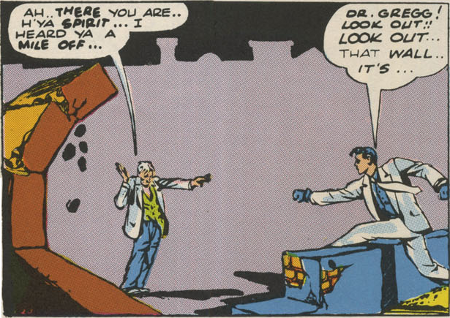
It was in Jules Feiffer's book, The Great Comic Book Heroes, that Buchanan and later I first encountered an untitled story by Will Eisner earlier published in the spring of 1941. Buchanan writes It showed me what comics could be. My reäction had been much the same. I'd seen some awfully good comic book art before I saw this story — Steranko's three issues of Captain America come immediately to-mind — but I'd just never seen anything like this. My sense of what a comic book could be was deeply changed.

(Later, I found more stories by Eisner, and discovered to my great dismay that Eisner had given the character of the Spirit a black side-kick who was depicted in a profoundly racist manner. I'm glad that that side-kick didn't appear in this story, so that my first exposure to work of such quality wasn't blighted.)

The Pictorial Arts

Monday, 20 April 2009

Last year, I posted a 'blog entry recommending that my readers visit Golden Age Comic Book Stories, where are found not just golden age comic book stories, but more generally a great many wonderful examples of the art of illustration.

By way of Golden Age Comic Book Stories, I've been led to another 'blog, the Pictorial Arts, to which I also want to give a strong recommendation. Like Golden Age Comic Book Stories, the Pictorial Arts features many examples of outstanding illustration. The Pictorial Arts differs in various respects. Most strikingly, its owner, Thomas Haller Buchanan, writes something of what the illustrations (and often the illustrators themselves) have meant to him, the rôle that they have played in his life.

Buchanan is himself a professional artist of superior ability; one gets to see some of his work

[portrait in chalk by THB]
image used with kind permission of artist
at another of his 'blogs, People Skills. At the Pictorial Arts he says little about that ability or about that work, but instead writes about work of other artists that he has found compelling, from the time that he was a small child up to the present. One may see not what he can produce, but that he could and can see as an illustrator would, and what he saw and sees that made him aspire to become an artist himself.

One of the things that I respect about Buchanan is that he posts about the work that he appreciates, regardless of its social standing. But what has me actually following his the Pictorial Arts is that I like so much of the work to which he directs attention. Some of it is by artists whom I have long admired; in some cases it is work that I too first encountered as a child and which made a strong impression on me. In other cases, I'd not seen it at all before I found it in his 'blog.

this ebony bird beguiling

Tuesday, 14 April 2009

As noted earlier, I've been reading Subjective Probability: The Real Thing by Richard C. Jeffrey. It's a short book, but I've been distracted by other things, and I've also been slowed by the condition of the book; it's full of errors. For example,

It seems evident that black ravens confirm (H) All ravens are black and that nonblack nonravens do not. Yet H is equivalent to All nonravens are nonblack.

Uhm, no: (X ⇒ Y) ≡ (¬X ∨ Y) = (Y ∨ ¬X) = (¬¬Y ∨ ¬X) = [¬(¬Y) ∨ ¬X] ≡ (¬Y ⇒ ¬X) In words, that all ravens are black is equivalent to that all non-black things are non-ravens.[1]

The bobbled expressions and at least one expositional omission sometimes had me wondering if he and his felllows were barking mad. Some of the notational errors have really thrown me, as my first reäction was to wonder if I'd missed something.

Authors make mistakes. That's principally why there are editors. But it appears that Cambridge University Press did little or no real editting of this book. (A link to a PDF file of the manuscript may be found at Jeffrey's website, and used for comparison.) Granted that the book is posthumous, and that Jeffrey was dead more than a year before publication, so they couldn't ask him about various things. But someone should have read this thing carefully enough to spot all these errors. In most of the cases that I've seen, I can identify the appropriate correction. Perhaps in some cases the best that could be done would be to alert the reader that there was a problem. In any case, it seems that Cambridge University Press wouldn't be bothered.


[1]The question, then, is of why, say, a red flower (a non-black non-raven) isn't taken as confirmation that all ravens are black. The answer, of course, lies principally in the difference between reasoning from plausibility versus reasoning from certainty.

Thicker than Water

Thursday, 2 April 2009

Yester-day, I again encountered the slogan No Blood for Oil!, made popular in the run-up to the invasion of Iraq.

I greatly doubt that the people who embrace this slogan have much thought about what it would really mean to forswear the use of violence over economic resources. Only a tiny minority are truly prepared to do that.

This proposition should be obvious in the case of those who want the State to actively participate in decisions about the allocation of resources. The point in having the State determine what quantities will be produced or to whom or to what production will go, or at what prices goods or services will be sold is to use violence or a threat of violence, effected by police and by prison guards. Were the economic administration to be by friendly persuasion, it could be done without the State.

Removing the State as an active participant doesn't utterly remove violence from the equation. If one believes that individuals or communities may forceably defend acquisition, retention, or distribution of goods or of services, then one accepts the use of violence over economic resources. It doesn't matter whether the forceable defense is provided by the State, by private protection agencies, by mobs, or by rugged individualists.

So if one believes that the state should provide the poor with home heating oil, or control gasoline prices, or if one believes in forceably defendable private property in petroleum or in forceably defendable anarcho-socialistic management of petroleum, then one believes in trading blood for oil.

In order to genuinely reject such an exchange, one would have to be truly and utterly pacifistic about petroleum, as are the Amish (albeït that a petroleum pacifist might be violent about other things).

Now, I surely don't claim that the United States should ever use its military in an attempt to secure foreign sources of goods or of services. (We can set aside debate over what the actual relationship were of the invasion of Iraq to American dependence upon Middle Eastern petroleum.) But simple-minded slogans and ad hoc moralizations don't typically propel discourse or move convictions in a humane direction.

To Hate All but the Right Folks Is an Old Established Rule

Wednesday, 1 April 2009

Years ago, a friend of mine used to regularly listen to right-wing talk radio. (I imagine that he still does.) I was often a passenger in his car, and there usually had to listen to this programming as well. What I heard drove me up a wall. These commentators didn't usually target people with whose views I agreed, but they routinely misrepresented the arguments that were used by their opponents, made ridiculous universalizations or near-universalizations about the motivations of these opponents, and pretended that the only alternatives to the views of the political left were those of the political right. And the abiding emotion was hate.

For the past few days, I have been visiting my parents. Nearly every evening, they watch MSNBC, and I catch some of it whenever I visit them. What I hear drives me up a wall. The commentators of MSNBC don't usually target people with whose views I agree, but they routinely misrepresent the arguments that have been used by their opponents, make ridiculous universalizations or near-universalizations about the motivations of these opponents, and pretend that the only alternative to the views of the political right are those of the political left. And the abiding emotion is hate.

For example, during this latest visit, I heard Rachel Maddow mocking William Kristol as ostensibly claiming a few weeks into the invasion of Iraq that the war was won, when what Kristol had actually said was that every battle had been decisively won. Were I now to claim that, a few weeks into the American Civil War, every battle had been decisively won by the Confederacy, I would plainly not be claiming that the Confederacy had won the war.

(Maddow was more generally concerned to pretend that the neoconservatives were trying to reposition and to repackage themselves as supporters of the war policy of the Obama Administration. The truth is that, in actual practice, this policy far more closely resembles that of the later Bush Administration than it does the policy described during the Obama candidacy. The neoconservatives, then, don't have to reposition much, though they plainly need to repackage if they are to regain active influence, since their persons and past organizations are anathematized.)

On top of being bothered by all this hate and misrepresentation in-and-of-itself, I am bothered that my father seems to be at least amused by this rubbish, and that my mother sort-of waves-away the fact that there's a stream of misrepresentation, and refuses to acknowledge that the hate is on a par with that of right-wing talk radio.

I end-up closing myself into the principal guest room, away from the television but also then away from my parents.

Amendment (2009:04/10): My father stated, last night, that while my mother likes Rachel Maddow, he finds Maddow unpleasant. Now, if only he would reject some of the other folk on MSNBC.

Un-American Activity

Wednesday, 25 March 2009

This story

Agency apologizes for militia report on candidates by Chad Livengood in the News-Leader
Missouri's Department of Public Safety has apologized to 2008 presidential candidates Ron Paul, Bob Barr and Chuck Baldwin for a state-issued report linking their political causes to the modern militia movement.

[…]

The Missouri Information Analysis Center's controversial Feb. 20 report has created a nationwide firestorm among conservatives in the past 10 days because it indicates people who support small government, refuse to pay taxes, oppose abortion and illegal immigration and voted for Paul and third-party candidates like Barr and Baldwin for president in the November 2008 election have tendencies to join violent militias.

[…]

But the Democratic governor and former attorney general has stood behind the report and MIAC's work.

[…]

The report also contains what it purports to be militia symbols. Among them is the Gadsden Flag and its Don't Tread On Me message, which was a battle cry of sorts for the country's founding fathers in the American Revolution.
is not getting much attention from the main-stream media.

I will be working on a Gadsden-flag bumper-sticker for my car.

For Lease

Tuesday, 24 March 2009

In the past, I've asserted that San Diego is seriously over-built. Hillcrest, the neighborhood in which I live, has many commercial sites that have been empty for some time. As an œconomist, I naturally wonder why the landlords haven't lowered the rent to a point where some party takes occupancy.

One possibility would be that the landlords were hoping for an up-turn in the economy. The possibility would make them more reluctant to commit to long-term leasing contracts at what would be present market-clearing rates, and might make them reluctant to even rent month-to-month, as there would be difficulties getting short-term renters out as quickly a more desirable renter might want to begin using the site.

Part of what would make it difficult to remove month-to-month renters would be local and state laws and regulations governing evictions. And other interventions in the market could be holding rents and vacancies at unnatural levels. For example, the structure of tax law might make sometimes make it advantageous to leave a property idle.

In any case, the numbers of vacancies, and durations of some of them, would be difficult or impossible to explain based simply on reference to market forces.


308 Washington Street, half-a-block from where I live, was a Hollywood Video rental store when I first moved to Hillcrest. (Most or all of their wares were VHS tapes at that time!) At some point, they hived-off perhaps a fifth of the site for digital electronic game rentals. Eventually, this section became a separate store, 302 Washington Street, and then Hollywood Video vacated that section, which was then rented to a UPS franchise store. Some time in late 2007 or in 2008, Hollywood Video shut down the store at 308 Washington Street. Since then, the building has stood about four-fifths empty, with a large sign advertising its availability.

Finally, yester-day, I saw a crew in the site gutting things in what I take to be the first stage of a renovation.

The last time that someone was poking-around in 308 Washington Street, I asked Scott, who works at the UPS store, lives in the same complex as I, and frequents the same coffee house (Babycakes) if he knew who the party was, and he said that rumor held it to be PetCo, which we agreed would be cool. Last night, Art, who lives in the same complex and works part-time at the coffee house express hope that the new store would be, er, a Denny's Restaurant, and didn't like the idea of a pet supply store there, in spite of being a dog-owner. Art sees PetCo stores as essentially big boxes like Wal·Mart stores. Well, there's some truth to that. On the other hand, Denny's Restaurants are open all day, almost every day of the year, and can be associated with a lot of traffic. Our immediate neighborhood could become more congested and louder late at night with a Denny's Restaurant. But I don't think them a likely renter there.

[Up-Date (2009:03/26): Scott tells me that word remains that 308 is to be occupied by a PetCo store.]