Archive for the ‘public’ Category

Noo ye kis ma boot or A strik ye wi ma whip!

Sunday, 30 January 2011

Somewhat to my surprise, I was recently able to get a copy of House of Tears (creditted to Harold Kane and illustrated anonymously by Joe Shuster).

At some point, I'd like to scan the thing,[1] but I don't want to damage it in the process of scanning, and the volume is bound in a way such that it does not naturally open flat. For now, I'll offer a verbal description.

The book is 20 sheets folded into five gatherings[2] to make a total of 80 pages. The gatherings are bound together by three staples, running from front to back but near the fold. A cover of dull-yellow paper, textured like parchment, is wrapped around these pages and glued to them at the fold. The volume is about 5 3/8 in × 8 in × 3/16 in (13.7 cm × 20.3 cm × .5 cm); I'd guess that it were printed on 8½-by-11 sheets before binding and trimming.

There are 65 pages of text that were almost certainly set with an elite[3] typewriter. There are ten full-page, black-and-white interior illustrations, two more than the eight that I discovered on-line. Both are plainly also by Shuster. One of these shows a fellow in a suit standing close behind a woman in a classic French maid's outfit; the other shows three women, one upon a throne-like chair, one in a dress lifting up her skirt to expose her lingerie, and the third behind her, apparently yanking or pinching her ear and dressed in a maid's outfit.

Although I've not read the story, it is apparently about a wealthy Illinois man who hires a Scottish woman to be the governess for his 15-year-old daughter, rather hoping that the governess will turn-out to be a dominatrix, and discovering that this is, indeed, the case. I cannot help but be amused at the thought of a household of Americans trying to figure-out what the H_ll a Scottish dominatrix is demanding of them, but a cursory investigation suggests that Miss Phyllis neither speaks Scots nor has a note-worthy accent. What I do see is a lot of space given over to sound-effects.

    Whshshshshshs...craaaaaaaccccckkkk...
pfffffffff-f-f-f-f-...wha-a-a-a-a-a-cckkkk
thwaaaaaccccckkkkkk.......

I'm not sure what that was, and perhaps I'm just better-off not knowing.


[1] No copyright registration was made, as this would have identified a person or a business entity that could be traced to owners, and those involved in production of this work could have been prosecuted under anti-pornography laws. It might be a fine thing to reverse the consequences of past censorship, and allow claims that could not have been registered to be made, but I believe that this particular work would then be orphaned.

[2] A gathering is a group of sheets stacked and folded together. The term signature is frequently mis-applied to gatherings.

[3] twelve characters per inch

Φ

Friday, 21 January 2011

At 08:48 on 8 September 2009, I had resubmitted my paper on indecision to a journal after replacing acknowledgements with place-holders. (The paper was originally submitted on 3 September, with the acknowledgements in-place and with a note from me that one of their editors was mentioned thereïn. The journal tossed it back to me to scrub the acknowledgments.)

To-day, then, at 08:48, we passed Day 500 since the (re)submission of the paper. Day 500, and the present status is Under review, which became its official status on 15 November of last year. (I earlier labored its previous status changes.) Doubtless that someone is thinking that they've only had the paper for 67 days, but the journal itself has had it for 500 days.

I am aware — Would that there were a G_d to help us all! — that 500 days is not a record for such delay. Still, economics journals which report their mean time-to-decision typically declare it to be something on the order of a month.

A Simple Tale

Wednesday, 19 January 2011

Some time within the last several weeks, I finally got around to reading The Secret Agent (1907), by Joseph Conrad. The novel is interesting for a number of reasons. One of those is that, as with Heller's later Catch-22, events are driven by the characters' unquestioned misunderstandings one of another, and by terrible narrowness of vision. (Unlike Catch-22, Conrad's book is not particularly humorous in its beginnings.) But what most struck me about The Secret Agent is that Conrad identified and unsparingly depicted the mental process that leads most who turn to state socialism to do so, and what essentially propels most of those who proceed on to left-wing anarchism to do that.

One of the characters of The Secret Agent is Stevie. Stevie is a low-functioning young man; operationally a person of very limited intelligence. He is also someone who is concerned — often overwhelmed with concern — about the fate of people and of beasts who seem to be ill-treated. Stevie's concern is illustrated at various points in the story, but it is in Chapter VIII that they begin to take political form.

Stevie's mother, over the objections of her daughter, has had herself moved to an alms-house; Stevie and his sister, Winnie Verloc, see their mother to her new home. The cab-man drives a much-abused horse to pull his carriage, and responds to Stevie's imploring that the horse not be whipped as if it were nearly incomprehensible. But, after the move has been effected, the cabbie tells Stevie that, however hard life may seem to be for the horse, it is harder still for the cabbie, who is a poor man with a family. Stevie is moved by this information. The driver departs.

Stevie is rejoined by his sister; they begin the journey homeward.

Before the doors of the public-house at the corner, where the profusion of gas-light reached the height of positive wickedness, a four-wheeled cab standing by the curbstone with no one on the box, seemed cast out into the gutter on account of irremediable decay. Mrs Verloc recognised the conveyance.[1] Its aspect was so profoundly lamentable, with such a perfection of grotesque misery and weirdness of macabre detail, as if it were the Cab of Death itself, that Mrs Verloc, with that ready compassion of a woman for a horse (when she is not sitting behind him), exclaimed vaguely:

Poor brute!

Hanging back suddenly, Stevie inflicted an arresting jerk upon his sister.

Poor! Poor! he ejaculated appreciatively. Cabman poor too. He told me himself.

The contemplation of the infirm and lonely steed overcame him. Jostled, but obstinate, he would remain there, trying to express the view newly opened to his sympathies of the human and equine misery in close association. But it was very difficult. Poor brute, poor people! was all he could repeat. It did not seem forcible enough, and he came to a stop with an angry splutter: Shame! Stevie was no master of phrases, and perhaps for that very reason his thoughts lacked clearness and precision. But he felt with greater completeness and some profundity. That little word contained all his sense of indignation and horror at one sort of wretchedness having to feed upon the anguish of the other—at the poor cabman beating the poor horse in the name, as it were, of his poor kids at home. And Stevie knew what it was to be beaten. He knew it from experience. It was a bad world. Bad! Bad!

Mrs Verloc, his only sister, guardian, and protector, could not pretend to such depths of insight. Moreover, she had not experienced the magic of the cabman’s eloquence. She was in the dark as to the inwardness of the word Shame. And she said placidly:

Come along, Stevie. You can’t help that.

The docile Stevie went along; but now he went along without pride, shamblingly, and muttering half words, and even words that would have been whole if they had not been made up of halves that did not belong to each other. It was as though he had been trying to fit all the words he could remember to his sentiments in order to get some sort of corresponding idea. And, as a matter of fact, he got it at last. He hung back to utter it at once.

Bad world for poor people.

Directly he had expressed that thought he became aware that it was familiar to him already in all its consequences. This circumstance strengthened his conviction immensely, but also augmented his indignation. Somebody, he felt, ought to be punished for it—punished with great severity. Being no sceptic, but a moral creature, he was in a manner at the mercy of his righteous passions.

Beastly! he added concisely.

It was clear to Mrs Verloc that he was greatly excited.

Nobody can help that, she said. Do come along. Is that the way you’re taking care of me?

Stevie mended his pace obediently. He prided himself on being a good brother. His morality, which was very complete, demanded that from him. Yet he was pained at the information imparted by his sister Winnie who was good. Nobody could help that! He came along gloomily, but presently he brightened up. Like the rest of mankind, perplexed by the mystery of the universe, he had his moments of consoling trust in the organised powers of the earth.

Police, he suggested confidently.

And there one has it. A great many of us would agree that the world is economically harder on many people than it ought to be. A great many of us would agree that society ought to do something about it. But the typical state socialist just unthinkingly grabs for the first social institution that comes to mind, the State; or, as Stevie puts it, police. There's no real thought to what other institutions might be more appropriate. If the point that we are talking about an institution that is first-and-foremost about violence is considered at all, there is little reflection on the question of whether and when violence is appropriate, unless that consideration is to rationalize the conclusion that violence should be used after the conclusion was already implictly embraced. But Stevie isn't drawn to wrestle with the a theory of what ought to be the limits of the State or of the use of violence:

The police aren’t for that, observed Mrs Verloc cursorily, hurrying on her way.

Stevie’s face lengthened considerably. He was thinking. The more intense his thinking, the slacker was the droop of his lower jaw.[2]

And it was with an aspect of hopeless vacancy that he gave up his intellectual enterprise.

Not for that? he mumbled, resigned but surprised. Not for that? He had formed for himself an ideal conception of the metropolitan police as a sort of benevolent institution for the suppression of evil. The notion of benevolence especially was very closely associated with his sense of the power of the men in blue. He had liked all police constables tenderly, with a guileless trustfulness. And he was pained. He was irritated, too, by a suspicion of duplicity in the members of the force. For Stevie was frank and as open as the day himself. What did they mean by pretending then? Unlike his sister, who put her trust in face values, he wished to go to the bottom of the matter. He carried on his inquiry by means of an angry challenge.

What for are they then, Winn? What are they for? Tell me.

Winnie disliked controversy. But fearing most a fit of black depression consequent on Stevie missing his mother very much at first, she did not altogether decline the discussion. Guiltless of all irony, she answered yet in a form which was not perhaps unnatural in the wife of Mr Verloc, Delegate of the Central Red Committee, personal friend of certain anarchists, and a votary of social revolution.

Don’t you know what the police are for, Stevie? They are there so that them as have nothing shouldn’t take anything away from them who have.

She avoided using the verb to steal, because it always made her brother uncomfortable. For Stevie was delicately honest. Certain simple principles had been instilled into him so anxiously (on account of his queerness) that the mere names of certain transgressions filled him with horror. He had been always easily impressed by speeches. He was impressed and startled now, and his intelligence was very alert.

What? he asked at once anxiously. Not even if they were hungry? Mustn’t they?

The two had paused in their walk.

Not if they were ever so, said Mrs Verloc, with the equanimity of a person untroubled by the problem of the distribution of wealth, and exploring the perspective of the roadway for an omnibus of the right colour. Certainly not. But what’s the use of talking about all that? You aren’t ever hungry.

Although it is plainly explained that Winnie is not really out to express a Machiavellian theory of the state, she has done so. Actually, many people from many otherwise very different ideologies would embrace this theory of what the State actually does; many anarchists (and not just left-wing anarchists) would insist that the State is at best unnecessary to all but those who would use to effect or to sustain an unjust distribution of economic power. But, in Stevie's case, in a matter of minutes he's invented state socialism, and then had his statism but not his socialism contradicted, and so heads down a path to left-wing anarchism. Someone else will later help him further down that path.


[1] The poor driver has taken his meager pay not home to his family, but to a pub. Earlier, it is revealed that a scrub-woman frequently plays upon Stevie's desire to help her and her family, only to spend on alcohol the money that he gives to her. Perhaps Conrad was inclined to believe that Work is the curse of the drinking classes. or perhaps he meant no more than to emphasize Stevie's gullibility. In any case, the interpretation is separable from what I seek principally to note.

[2] Note that Conrad has written Stevie as quite literally a slack-jawed fool.

Diminished

Tuesday, 4 January 2011

I've lost about 20 lb (which corresponds to about 9 kg) recently, moving to the center from the high end of the normal range for my height. (I'm about 5ft 10in, which is just less than 178 cm.)

I'd not been weighing myself, but my clothes were tighter than I wanted, and I was unhappy with my appearance. I guessed that I needed to lose about 10 lb. I got out a scale and weighed myself, it told me that I weighed about 168 lb (which corresponds to 76.2 kg). Based on a table that I consulted, I decided to get down to 156 lb, so I lost 12 lb.

But, looking at more tables, I was seeing that, pretty consistently, a weight of 151 lb would be dead-center in the normal range. I decided to retarget to that. That would be another 5 lb.

Then, because my old, mechanical bathroom scale was acting-up, I got a new, electronic scale. It consistently gave a reading of about 3 or 4 lb more than did the old scale. *sigh*.

Anyway, according to the new scale, I dipped below 151 lb to-day. (That weight corresponds to about 68½ kg.) My programme was basically just one of reducing my intake of food-stuffs. I hadn't been eating a lot, but apparently my metabolism is pretty slow.

Norman Rockwell's Americans

Monday, 13 December 2010

A confluence of events, including particularly a recent entry at Grantbridge Street, brought me to a new reälization about Norman Rockwell's great masterpiece,

The point has been thoroughly belabored that Rockwell's recurring theme was a vision of America. I want to draw attention to the specific that this vision of America isn't much of amber waves of grain or of redwoods; it is of people; his recurring theme was Americans — a sort of people — as he saw them. In image after image, Rockwell painted Americans. [image of burly female riveter] [image of returning soldier being greeted in tenement neighborhood] [image of police officer, small boy with bindle, and short-order cook at counter] It would be a mistake to say that these were Americans as Rockwell wished them to be. Rather, these are people as Rockwell conceptualized Americans. He does not generally make them pretty; they are apt to have craggy or slightly comical faces, to be noticeably scrawny or chubby rather than athletic in appearance. But there is an underlying idealization here. It is not one of place; to be an American is neither to be within nor to be from a region; the concept of American here is more akin to one of culture, but there's a better term for what it really is.
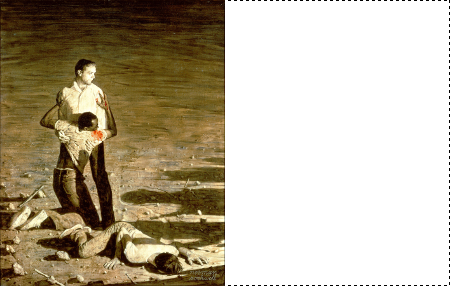
With his having made all of these images of Americans, to be painted by Rockwell was to be depicted as an American. When Rockwell painted Chaney, Goodman, and Schwerner, he painted three Americans. [image of Chaney, Goodman, and Schwerner, being murdered] Indeed, for Rockwell, these three must have been very American, because here to be an American is to embrace an ethos. Americanism is an ethos.

The viewer sees only the shadows of the killers. It could be argued that Rockwell didn't know how the killers looked, but he could have dressed them in white sheets. It could be noted that they seem more menacing in this way, and perhaps Rockwell wanted that effect. But the main reason that they are out-of-frame is because Rockwell painted Americans.

Unappealing Court Logick

Tuesday, 7 December 2010
Court weighs constitutionality of gay marriage ban by Paul Elias & Lisa Leff of the AP

The panel […] seemed worried about allowing the governor and attorney general to effectively kill Proposition 8 by refusing to defend it.

Note that the question here is not whether state officials are required to defend the law in the original hearing, but whether officials are permitted to accept the ruling of the lower court when that ruling rejects a measure. If officials are not permitted to accept such a ruling by a lower court as to the constitutionality of a measure, then one has to ask why these matters shouldn't as a rule go first to the Supreme Court.

Given the present court system, requiring state officials to exhaust their appeals in defense of a measure would creäte an asymmetry in favor of whatever measure had passed; laws would always have to be accepted as in accord with the constitution unless challengers had the resources to fight all the way to the Supreme Court. Beyond that, the residual function of the lower courts would be to allow appeals courts and the Supreme Court to moderate their work-loads by refusing to hear an appeal.

The question of whether supporters of Proposition 8 have standing to appeal the lower court ruling should turn not upon whether this were the only way to ensure that a law is fully defended, nor upon whether it is the only way that what may plausibly be their rights should be defended, but upon whether indeed it is at all plausible that their rights are at stake, regardless of whether state officials are doing anything to protect those rights. If a party were not given standing to defend its rights, on the grounds that state officials were providing such a defense, then state officials could erode those rights by providing a weak defense.

Installing Haskell to Red Hat Enterprise Linux 6.x

Saturday, 27 November 2010

I don't normally draw packages from EPEL, because some of them have conflicted with packages from other repositories that I use. But packages for Haskell on RHEL can be found there, and I haven't found working .RPMs elswehere. On the assumption that one is going to use those EPEL packages, gmp-devel, which is available from RHN, must be installed. To do so, as root, enter

yum install gmp-devel

There are at least a couple of ways to fetch and install the EPEL packages for Haskell. I think that the easiest is to use yum. As root, creäte a file

/etc/yum.repos.d/epel.repo
with contents
[epel]
name=RHEL 6 - epel - $releasever - $basearch
baseurl=http://download.fedoraproject.org/pub/epel/beta/6/$basearch/
gpgcheck=0
enabled=1
priority=1
exclude=*release
Then as root enter
yum install haskell-platform
(After that, as root I delete that .repo file
rm /etc/yum.repos.d/epel.repo
so as not to have those previously mentioned conflicts with packages from other repositories.)

Installing OpenOffice 3.2.x under Red Hat Enterprise Linux 6.x

Friday, 12 November 2010

If you’re actually trying to install another version of OpenOffice or under a different version of RHEL, then click on the OpenOffice tag, as there may be an entry on that other version.

My suggested procedure for installing OpenOffice 3.2.x under RHEL 6.x is essentially the same, mutatis mutandis, as that for installing OpenOffice 3.2.x under RHEL 5.x.:

  1. If you don't have a JRE installed, then install one. As I write, Sun is at update 22 (while OpenOffice is at update 20), but check with Sun for a more recent version when you are installing OpenOffice. (I suggest that one use jdk-6uxx-linux-xxx-rpm.bin or jre-6uxx-linux-xxx-rpm.bin, rather than jre-6uxx-linux-xxx.bin.) The remainder of these instructions assume that one has a JRE installed.

  2. Remove any earlier installation of OpenOffice. As root, enter these three commands:

    rpm -qa | grep openoffice | xargs rpm -e --nodeps
    rpm -qa | grep ooobasis | xargs rpm -e --nodeps
    rpm -qa | grep fake-db | xargs rpm -e --nodeps

  3. Unpack OOo_3.2.x_LinuxIntel_install_wJRE_en-US.tar.gz (or the version appropriate to a devil-language, if you use one of those) to your filespace.

  4. Go into resulting OOO32x_mxx_native_packed-x_en-US.xxxx/RPMS/ (or to the OOO32x_mxx_native_packed-x_xx-xx.xxxx/RPMS/ corresponding to your devil-tongue).

  5. As root, run

    find . -maxdepth 1 -name "o*.rpm" | xargs rpm -U

  6. As root, run

    rpm -U desktop-integration/openoffice.org*-redhat-menus-*.noarch.rpm
    (NB: You may need to log-out and back-in for the Applications menu to be up-dated and list the latest OpenOffice components. Your previous version may continue to be listed on the menu.)

  7. As root, run

    rpm -U userland/*.rpm

  8. Tell OpenOffice which JRE to use:

    • Launch OpenOffice:
      /usr/bin/openoffice.org3
      (It may not be listed on the applications menu unless you have logged-out and back-in. Before then, you may be able to launch it from the menu by way of a listing for a previous version.)
    • Select
      Tools | Options… | OpenOffice.org | Java | Use a Java runtime environment
    • Choose one of the environments that is then listed.
    • Click the OK button.
    • Shut-down OpenOffice. (The selection of JRE will be in effect upon next launch.)

American Language

Monday, 1 November 2010

After one votes in California, one is offered a sticker announcing that one has done so. In my area, the stickers are typically available in English, in Spanish, and in Vietnamese. I ask for one in Vietnamese.

There are people who want English to be constitutionally declared to be the language of America; they are stunningly wrong.

Of most immediate importance, they are wrong because, whenever anything is made a matter of law, it is made a matter of force; behind any law is ultimately a gun. There are times for laws because there are times for force; there are times for guns. But language choice is not such a time. I have only contempt for someone who claims that there is a symmetry between being forced to speak the language of a merchant because he will not transact in another language and that merchant being forced by the state to transact in some other language, or official proceedings being legally restricted to a language utterly alien to important parties. (And my contempt extends to those who would force the use of minority languages, as well or instead of majority languages.)

Perhaps of even greater long-run importance, if a language is made an official language, the state is thereby empowered to determine whether this-or-that communication conforms to that language, which is to say that control of a language is seized by the state when the language is made official. The state develops the power to decide its grammar and its vocabulary.

America was given a foundation, however imperfect, of classical liberalism. It represents a gross violation of that foundation to tell people in what language they must express themselves, and a gross violation of that foundation to offer-up control of one of our languages to the state.

One of our languages. English is one of our languages; there are others. Any language spoken by an American is an American language. (And any name held by an American is an American name.) And there are people who don't know English who are far better Americans than those who would give that language a legally privileged position.

Daylight-Losing Time

Wednesday, 27 October 2010

The temptation of Daylight-Savings Time is easy to explain. If one times the activities that need light to occur as little as possible during times when light would have to be artificially generated, then one saves resources. As one moves away from the Winter Solstice, the time between sunrise and sunset lengthens, and the amount of natural light available in the mornings increases. We used time zones so that clocks are synchronized over reasonably large areas, rather than just long lines of longitude. And re-setting clocks is less failure-prone and otherwise cheaper than changing time-tables.

Unfortunately, Daylight-Savings Time doesn't really work. Worse, it kills people.

In the contiguous United States (the lower 48), the difference between the time of sunrise at the summer solstice and at the winter solstice is about two hours, and it's not as if the change takes place all at once. When an hour is added to the clocks, activities that were beginning at about sunrise are immediately beginning about an hour before sunrise; it takes more than a month for the seasonal change to catch-up to the clock change, and later in the year, as sunrise again has begun to take place later, there will be another month during which the seasonal difference is less than the clock difference. And the clocks through-out each time-zone, all the way to its western border, are typically being kept in synchronization with those on the eastern border; with time-zones being about an hour wide, activities that were taking place up to an hour after sunrise on the eastern border are taking place at or before sunrise elsewhere in the time zone. So we shouldn't be terribly shocked that statistically studies haven't been able to tease-out much-if-any actual savings associated with Daylight-Savings Time.

Meanwhile, it has been observed that, as the nation goes on or off Daylight-Savings Time, there is an increase in automobiles hitting pedestrians. That's because drivers adjust imperfectly to the apparent sudden change in how dark it is in the morning or in the evening. They are driving in the morning or in the evening as if it is lighter than it is, and the fact that they are driving as if it is darker than it is at the other end of the day doesn't offset the effects (because the marginal effect of caution is diminishing). When Daylight-Savings Time is begun, there an addition element of people being poorly rested; the effect is not much off-set by people being better rested when Standard Time is resumed.


