Archive for the ‘philosophy’ Category

Presidential Prognostications

Monday, 15 June 2009

I am not at all sanguine about the oppositional up-rising in Iran. Although it is evident that Ahmadinejad's faction rigged the counting of the vote, I think that he would have won, by approximately the same margin, had the votes been honestly counted. I see the up-rising as that of a minority, and of a minority that is considerably less thuggish than the majority whom they oppose.


Meanwhile, I am fairly sure that, by the end of the calendar year, the attempt by our own President to reëngineer America will have failed, and that the changes that he will have been able to effect will, over-all, be viewed by most Americans as wrong-headed in one way or another.

In some future entry, I'll have more to say about my perceptions of his programme.

Other Statistical Analysis

Sunday, 14 June 2009

Meanwhile, Andrew Sullivan notes the The Results as They Came In for the Iranian Presidential election. Specifically, as the official figures were up-dated, they fell almost perfectly along a straight line. The fit has an R2 of .998, which is a virtual impossibility. So the official figures are a bald lie. That doesn't mean that Ahmadinejad wouldn't have won under a fair count, but it means that he chose to steal the election rather than to risk losing under a fair count.

Increase as Alleged Evidence of Downward Trend

Sunday, 14 June 2009
From Ideas, the 'blog of David D. Friedman:
Global Sea-ice, Deceptive Reporting, and Truthful Lies, 12 May 2009:

The latest Arctic sea ice data from NASA and the National Snow and Ice Data Center show that the decade-long trend of shrinking sea ice cover is continuing.

That statement, from the JPL, is dated April 2009. The actual data for northern hemisphere sea ice, measured as the deviation from its 1978-2000 mean, are shown below. The source is The Cryosphere Today, a web site of the Polar Research Group, Department of Atmosphere Sciences, University of Illinois at Urbana-Champaign, not a site devoted to critics of global warming. […]

Looking at the graph, the pattern is pretty clear. For about ten years, from 1997 to late 2007, the area of sea ice was decreasing. That trend then reversed, and the area has now been increasing for more than a year. […].

Sea Ice II: Reading Graphs, 13 May 2009:

On the other hand, poking around the same source, I found the graph for March, which provides at least a little support for the JPL comment I have been attacking, which was published in April. It shows March sea ice rising a lot for two years, but falling a little in the most recent year. To describe that as "continues to shrink" strikes me as clearly misleading, but it's an exaggeration to describe it as a flat lie.

Arctic Sea Ice Briefly Continued, 11 June:

[…] I emailed someone at NASA. […] Eventually he conceded that he was a media person, not a scientist, sent my question off to a scientist at the National Snow and Ice Data Center, and sent me the response.

[…].

I got back an evasive answer that came down to (not a quote) the long term trend is down, so objecting that JPL says the current data shows that trend continuing when it doesn't is merely a technical semantic objection.

Ill-Remembered History

Monday, 1 June 2009

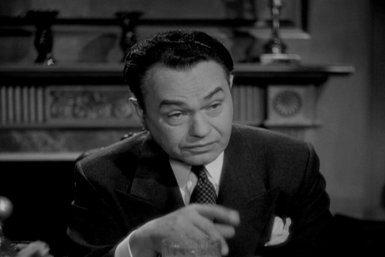
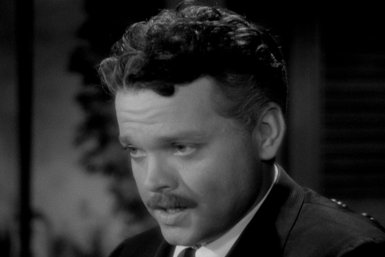
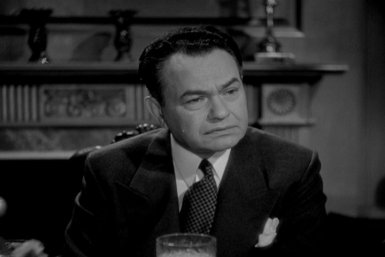
Recently, I began watching The Stranger (1946) for the first time in many years.

There are many things that one might say about this film, and in particular about the sociological aspects of this film. Here, I want to draw attention to one in particular.

Here's a clip:


On another page, I provide a fairly full transcription of the dialogue for the whole clip. Here, let me focus on a shorter excerpt from within this clip.

Dramatis Personæ
Mr Wilson(Edward G. Robinson)undercover agent of the Allied War Crimes Commission
Franz Kindler
aka Charles Rankin
(Orson Welles)fugitive Nazi official, living under an assumed identity
Adam Longstreet(Philip Merivale)Justice of the SCotUS
Mary Rankin
née Longstreet
(Loretta Young)daughter of Judge Longstreet,
newlywed bride of Charles Rankin
Noah Longstreet(Richard Long)son of Justice Longstreet
Jeffrey Lawrence(Byron Keith)town doctor
Red(unknown)Mary's dog


Wilson: Do you know Germany, Mr. Rankin?
Charles: I'm sorry, I— I have a way of making enemies when I'm on that subject. I get pretty unpopular.
Wilson: Well, we shall consider it the objective opinion of an objective historian.
Charles: Historian? A psychiatrist could explain it better. The German sees himself as the innocent victim of world envy and hatred — conspired against, set upon by inferior peoples, inferior nations. He cannot admit to error, much less to wrongdoing, not the German. We chose to ignore Ethiopia and Spain, but we learned, from our casualty list, the price of looking the other way. Men of truth everywhere have come to know … for whom the bell tolled. But not the German. No, he still follows his warrior gods, marching to Wagnerian strains, his eyes still fixed upon the fiery sword of Siegfried. And [glances at Jeffrey] in those subterranean meeting places that you don't believe in, the German's dreamworld comes alive and he takes his place in shining armor, beneath the banners of the Teutonic Knights. Mankind is waiting for the Messiah; but, for the German, the Messiah is not the Prince of Peace. No, he's… 'sanother Barbarossa, another Hitler.
Wilson: Well, then, you, uh, you have no faith in the reforms that are being effected in Germany.
Charles: I don't know, Mr. Wilson. I can't believe that people can be reformed except from within. The basic principles of equality and freedom never have, never will take root in Germany. The will to freedom has been voiced in every other tongue [Wilson nods.] — All men are created equal, liberté, égalité, fraternité — but in German—
Noah: There's Marx: Proletarians, unite. You have nothing to lose but your chains.
Charles: But Marx wasn't a German; Marx was a Jew.
Justice Longstreet: But, my dear Charles, if we concede your argument, there is no solution.
Charles: Well, sir, once again, I differ.
Wilson: Well, what is it, then?
Charles: Annihilation. Down to the last babe in arms.
Mary: Oh, Charles, I can't imagine you're advocating a … Carthaginian peace.
Charles: Well, as an historian, I must remind you that the world hasn't had much trouble From Carthage in the past … 2,OOO years.
Justice Longstreet (chuckling): Well, there speaks our pedagogue.
Mary: Well, uh, speaking of teachers, Mr. Wilson, …
Wilson: Yes, huh?
Mary: The faculty is coming for tea next Tuesday. If you have nothing better to do, would you like to join us?
Wilson: Uh, I'd like to, but my work here is finished. [Charles smiles faintly.] I'm leaving Harper tomorrow.

(Later, Charles and Mary Rankin enter their home.)
Mary: Extraordinary, isn't it, clocks being Mr. Wilson's hobby, too?
Charles: Yes, isn't it?
Mary: Well, Red, how do ya like your new house?
Charles: He loves it. Come here, Red; I think I'll take you for a walk. Come here, boy.
Mary: Oh, darling, you don't have to take him out. Just let him out. He won't run off.
Charles: I need the walk; I'm restless. Come on, boy.

(At Wilson's room.)
Male voice from phone: That's good. How are you coming along?
Wilson: I'll be in Washington tomorrow afternoon. You were right about Rankin. He's above suspicion.

Notice that Professor Rankin has advocated genocide — wiping-out the Germans Down to the last babe in arms. The only person at the table who raises the slightest objection is Mary, and even her response is mild. Wilson, the principal hero of the story, concludes from this advocacy that Professor Rankin is above suspicion — the emphasis on above is Wilson's — rather than, say, a pathological Germanophobe.

When Americans remember the war and its aftermath, we tend to forget that there was a time when preaching genocide, while a minority position, was socially acceptable. In fact, such sentiment reached up to the highest levels of government. Here are a couple of excerpts from The New Dealers' War by Thomas Fleming (which excerpts may be familiar to those who followed my LJ):

New Dealers and others around the president made no attempt to alter this dehumanizing war against the Japanese. In September 1942, Admiral William Leahy, Roosevelt's White House chief of staff, told Vice President Henry Wallace that Japan was our Carthage and we should go ahead and destroy her utterly. Wallace noted this sentiment without objection in his diary. Elliot Roosevelt, the president's son, told Wallace some months later that he thought Americans should kill about half the Japanese civilian population. New Dealer Paul McNutt, chairman of the War Manpower Commission, went him one better, recommending the extermination of the Japanese in toto.

[…]

At the White House on August 19, 1944, [Secretary of the Treasury] Henry Morgenthau told Roosevelt the British were much too benevolent in their postwar plans for Germany and so were the State Department and the European Advisory Commission. The Secretary was, incidentally, shocked by FDR's appearance. He is a very sick man and seems to have wasted away, he told his diary. But that observation did not deter him from urging the president to stop this soft approach to Germany.

Roosevelt's animus against the Germans erupted into fury. Give me thirty minutes with Churchill and I can correct this, he told Morgenthau. We have got to be tough with Germany and I mean the German people, not just the Nazis. You either have to castrate [them] or you have got to treat them … so they can't just go on reproducing people who want to continue the way they have in the past.

Morgenthau left the White House convinced that he had a mandate to create a better plan to deal with postwar Germany. He put Harry Dexter White in charge of a special committee to draft the Treasury's analysis of the German problem. The result was the Morgenthau Report. It proposed to divide Germany into four parts. It also recommended destroying all the industry in the Ruhr and Saar basins and turning Central Europe and the German people into agriculturists. At one point Communist agent White, who was described by his Soviet handler as a very nervous cowardly person, feared they were going to extremes. He warned Morgenthau this ideal was politically risky; it would reduce perhaps 20 million people to starvation. I don't care what happens to the population, Morgenthau said.

Foreign Policy — Theory and Practice

Wednesday, 27 May 2009

Proponents of a multilateralist foreign policy have treated the consequences of the post-9/11 foreign policy of the Administration of GW Bush as a sort of proof of the merits of multilateralism over unilateralism.

Part of the problem with this argument is that, while the invasion and occupation of Iraq was essentially unilateralist, the earlier invasion and occupation of Afghanistan was multilateralist, and that invasion doesn't seem to have been a comparative success.

Moreover, politically weakened when the Rumsfeld strategy failed, the Administration was compelled to pursue a multilateralist policy with respect to Iran and to North Korea. Again, the policy does not seem to have worked.

In fact, the war with Iraq was not begun under that Administration, nor was it begun unilaterally. It was begun in early 1991, as a multilateral policy under the Administration of GHW Bush, and continued as such under the Clinton Administration. After more than twelve years of undeclared multilateral warfare, forceably embargoing Iraq and lobbing missiles at them, and the deaths of an enormous number of Iraqis, with Saddam Hussein trying to bide his time until it became impossible for the United States to remain in Saudia Arabia, the United States switched to a unilateral war policy.

Also during the Administration of the elder Bush, the United States participated in the multilateral invasion and occupation of Somalia. (At its outset, the mainstream media celebrated it as a sort-of proof-by-expectation of the merits of the UN.) That wasn't exactly a success either. (But, somehow, not taken as proof-by-outcome of the deficiencies of the UN.)

Now, proponents of multilateralism variously argue that they just need(ed) more time, that the specific implementations have been defective but the general approach is none-the-less appropriate, or that their policy is imperfect but less of a failure than the alternative. Unilateralists present the isomorphic arguments got by swapping uni and multi.

The last form of argument, that the policy is better than the alternative hangs on the notion that the only one alternative exists; that we must have either unilateralist entanglements or multilateralist entanglements. Well, that's certainly not logically true. Logically, we might simply avoid entanglements altogether. Instead of having our diplomats author or co-author Strongly Worded Declarations, we might tell our diplomats to just shut-up. Instead of trying to police the world in-or-out-of NATO, we might send our troops over-seas exactly and only when specifically attacked within our own territory.

I don't know that military isolation would spare us any grief. While a very large share of the present problems of America are caused by the past misdeeds of the United States, I'm of the opinion that indeed a large part of the world hates America because they see its liberalism (tattered as it may be) as an obscene rebuke to their own cultures, and dread that, in the absence of violence, that liberalism would over-sweep their cultures. And that part of the world would use the past sins of the United States as an excuse to fly planes into our buildings for decades after the United States tried to withdraw. But, in spite of my practical doubt, and in spite of my not knowing just how to transition, I'm convinced that we need to move towards military isolation, and to keep moving until we get there and can stay there.

In any case, when you evaluate the foreign policy of the United States, consider the invasion of Iraq, but also consider the dozen years of war before that; consider Afghanistan, consider Iran, consider North Korea, consider Somalia, consider the Sudan. Don't compare practical unilateralism to mythical multilateralism.

Candidata and Candidate

Wednesday, 27 May 2009

Back when Barack Obama and John McCain had selected their respective running-mates for the Presidential race, a 'Net friend wrote

[…] it does seem that Obama picked the best person to help him govern, whereas McCain picked the best person to help him win.

which was certainly a plausible interpretation of the choice (so long as we tweak it to refer to the expectations of Obama and of McCain).

Now Obama has nominated an appointee to the Supreme Court who is unlikely to sway other judges in favor of left-wing opinion:

The Case Against Sotomayor by Jeffrey Rosen of the New Republic 04 May 2009

[…] Most are Democrats and all of them want President Obama to appoint a judicial star of the highest intellectual caliber who has the potential to change the direction of the court. Nearly all of them acknowledged that Sotomayor is a presumptive front-runner, but nearly none of them raved about her. They expressed questions about her temperament, her judicial craftsmanship, and most of all, her ability to provide an intellectual counterweight to the conservative justices, as well as a clear liberal alternative.

The most consistent concern was that Sotomayor, although an able lawyer, was not that smart and kind of a bully on the bench, as one former Second Circuit clerk for another judge put it. She has an inflated opinion of herself, and is domineering during oral arguments, but her questions aren't penetrating and don't get to the heart of the issue. (During one argument, an elderly judicial colleague is said to have leaned over and said, Will you please stop talking and let them talk?) […]

Sotomayor has infamously asserted

I would hope that a wise Latina woman with the richness of her experiences would more often than not reach a better conclusion than a white male who hasn’t lived that life.

Well, the logician in me wants to point out that the decisions of any wise person (Latina or otherwise) can be be expected to be better over-all than the decisions of a typical person (white and male or otherwise); wisdom simply isn't typical. So if Sotomayor hadn't implicitly inserted a second wise in front of white male, then she would have expressed something basically true but close-on to vacuous, and cluttered-up with inappropriate adjectives.

Unfortunately, she was arguing against the claim that a wise old man and wise old woman will reach the same conclusion in deciding cases, so she was arguing for a sort of sexism, at least a sexism conditional upon race.

In any case, the problem is that Sotomayor herself isn't wise. That leaves the (somewhat redundant) Latina woman part. That part wouldn't help her to reach better decisions or even to argue effectively for whatever judgments she reached, but it would help the Democrats in future elections and help Obama in particular.

(The Republicans are in poor position to complain about such a selection. When running for President in 1980, Ronald Reagan promised that his first nominee to the SCotUS would be a woman. Worse, the woman whom he nominated was Sandra Day O'Connor, whose judicial philosophy, such as it was, was baddumbmommism — an insistence on ending specific conflicts by imposing pragmatic compromise.)

Tyranny of the Plurality

Tuesday, 26 May 2009

There isn't a whole lot to be said about this decision.

The ruling declared that

It is not a proper function of this court to curtail that process; we are constitutionally bound to uphold it.

But, in fact, the process specified by the state constitution does not allow any-and-all amendments that can find support amongst a plurality of voters. The court chose to put democracy ahead both of the constitution and of personal freedom.

A Real Coup for the Press, II

Tuesday, 26 May 2009

Back in December, I drew attention to:

The Death of Deep Throat and the Crisis of Journalism by George Friedman at StratFor
The story of Deep Throat was well-known, but what lurked behind the identity of Deep Throat was not. This was not a lone whistle-blower being protected by a courageous news organization; rather, it was a news organization being used by the FBI against the president, […].
Now:
US paper missed Watergate scoop from the BBC:

The story began on 17 June, 1972, when a group of men were caught breaking into the Watergate complex in Washington DC. They were attempting to plant listening devices in the offices of the Democratic National Committee.

Robert Smith says that two months later — on his last day at the New York Times — he had lunch with the acting director of the FBI, L Patrick Gray.

In an interview with the BBC, Mr Smith recounts how Mr Gray began divulging details of the Watergate break-in, a range of other illegal political activity, and the Nixon administration's attempts to cover it up.

Again, the big story is right there, but being ignored: The FBI set-out to covertly bring-down a Presidential Administration. Now we see that two major papers were positioned to recognize this, and each concealed this coup from the public.

The Batman

Tuesday, 19 May 2009

In 1992, Tim Burton made a movie, Batman Returns, in which his alleged Batman sees a woman fall from a ledge on a building. The supposed Batman waddles to the edge, looks over, and watches her fall to her death.

If the actual Batman sees a woman tossed from a building ['Moon of the Wolf' pg3 panel 3] then he immediately jumps after her ['Moon of the Wolf' pg3 panel 4] pushes off something because she's been accelerating under gravity ['Moon of the Wolf' pg3 panels 5 and 6] and figures-out what he'll do on the way down ['Moon of the Wolf' pg3 panel 6] because he's the g_dd_mn'd Batman, when there's no hope…

…except him.

Moon of the Wolf, by Len Wein, Neal Adams, and Dick Giordano, from Batman #255 (April 1974), is reproduced at a Grantbridge Street entry for 18 May.

Clean, Humane, and Long

Monday, 11 May 2009
How selfish soever man may be supposed, there are evidently some principles in his nature, which interest him in the fortune of others, and render their happiness necessary to him, though he derives nothing from it except the pleasure of seeing it.
Adam Smith
The Theory of Moral Sentiments
Pt I § I Ch I ¶ 1

Thus begins Adam Smith's first book, in its editions of 1759, 1761, 1767, 1774, 1781, and 1790. In other words, he was saying this both before and after his more famous work, An Inquiry into the Nature and Causes of the Wealth of Nations (1776, 1778, 1784, 1786, & 1789). At some point, I may write a lengthier entry on what Smith was doing with the Wealth of Nations, but I wanted to make the point that Smith didn't make his case for a free market based upon a personal belief that one only cared for others based upon their effects on one's own material well-being. Rather, he made his case (in the Wealth of Nations) for the optimality of a free market without availing himself of the proposition that people otherwise gave a d_mn about each other. Then, as now, many opponents of a free society held that an economy without extensive state control could work only if people had more fellow-feeling than they actually do.