Archive for the ‘commentary’ Category

A buck or a pound / A buck or a pound

Monday, 27 October 2008

As European politicians and pundits tut-tut over the ostensible relative deficiencies of American economic policy, pay attention to what is happening to exchange rates.

By itself, the absolute level of exchange rates isn't particularly meaningful — that's really just a matter of scaling. but movements of exchange rates are significant. When the value of one currency is dropping relative to that of another, it means that people are trying to shift holdings in the former to holdings in the latter.

These days, the dollar is generally strengthening with respect to the pound and with respect to the euro, which means that people are trying to increase their share of currency that buys stuff in America relative to their share of currency that buys stuff in Europe.

That doesn't mean that economic conditions in America aren't bad, but it strongly argues that conditions in Europe are worse.

I have sought, but I seek it vainly

Sunday, 26 October 2008

When they notice that I have shut-down my computer and am packing to leave, people intending to be helpful sometimes unplug my computer. Unfortunately, they often or always do so by pulling on the cord itself, rather than the plug. Largely as a result, I have had yet another cord begin to fail recently. I have some replacements on-order, but I also plan to repair the three failing cords that I have at-hand.

A failure is almost invariably where the plug joins the cord, such that replacing the plug will restore the unit. Further, I could get a plug with some sort of sleeve, so that people would be grabbing that, rather than the cord.

To-day I have looked for replacement plugs at CVS, at Fry's Electrionics, at Radio Shack, and at Target, unsuccessfully at each place. (I could have bought a whole power cord at Fry's Electronics, but I need a cord with a special sort of plug at its other end, to join it to a power adapter.) I was fairly certain that I could find some at Ace Hardware (to which I would have gone to-day had they been open while I was running errands); but my search of their website yielded surprised disappointment.

It used to be that replacement plugs were readily found at the sorts of places to which I went. There world has changed in a small-but-telling way. People are far less inclined to repair electrical devices than once they were; they more often simply discard them. A large part of that shift is almost surely economically efficient — repairs can consume more resources than replacements — but it's also part of a larger trend of people becoming ever less able to do things for themselves, and that saddens me.

Up-Date (2008:10/27): ForensicEye (by way of the Woman of Interest) informs me that he gets replacement plugs at Home Depot

Up-Date (2008:10/30): I noticed that the website for Home Depot did not list any replacement plugs, in spite of the assurance from ForensicEye that plugs can be found in their stores. So I called to check whether a similar situation obtains with respect to Ace Hardware, and was told that they carry them in their stores despite the lack of listing on their website. So the plugs are more difficult to find than once they were, but we're not reached the point where Ace Hardware doesn't have them.

Worse than I'd Imagined

Thursday, 23 October 2008

Oog.

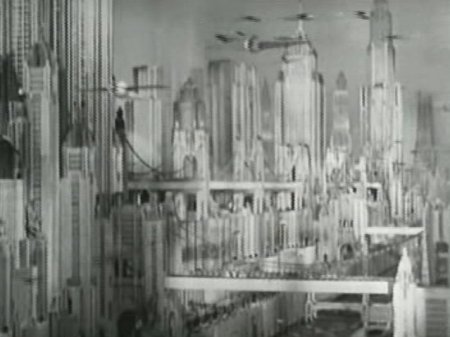
For many years, I've been curious about Just Imagine, a 1930 science-fiction film ostensibly depicting the world of 1980, when airplanes have replaced cars, pills have replaced food and drink, and designators such as LN-18 have replaced names as we know them.

I finally got a copy a few days ago, and this morning I finished watching it. It's a remarkably bad film — bad science, bad plot, bad acting (even Maureen O'Sullivan is hard to take), bad jokes, bad songs, bad choreography. And bad mathematics, as someone who was a little boy in 1930 has become someone in his seventies or older.

The state has intruded into people's lives in various ways, but these ways are more inane than ominous, without having much satiric value. For example, the elimination of old-fashioned names isn't accompanied by any discernible attempt to rob people of individual identity. LN-18 is called LN (pronounced /ɛlˈɛn/), which might as well be Ellén, and J-21 is called J (/djeː/), which might as well be Jay. The romantic conflict exists because the state must decide which of two men shall marry LN-18, but only because she approved an application from each. And, rather than making a better case that she should have been able to withdraw such permission, the movie concludes with the state ultimately choosing the man for her whom she loves.

(For an evaluation very different from mine, see the review from the New York Times, 22 November 1930.)

Post Apocalypse

Thursday, 23 October 2008

I got a note the other day referring to 12:00p.m when its author plainly meant noon.

Okay, now, folks, p.m. stands for post meridiemafter noon. Noon isn't after itself. There is a 12:01 p.m., a 12:00:01 p.m., a 12:00:00.0…01 p.m.. But if there is any 12:00 p.m., then it would be mid-night; which, awkwardly, is also the only candidate for 12:00 a.m., since noon also isn't before noon (ante meridiem) either.

Calling noon 12:00 m. would just confuse people, as they'd take the m. as standing for midnight, but 12:00 n. is nicely unambiguous.

Suppressing the Dirty Truth

Monday, 20 October 2008
Blow to image of green reusable nappy by Marie Woolf at the Times
The Department for Environment, Food and Rural Affairs (Defra) has instructed civil servants not to publicise the conclusions of the £50,000 nappy research project and to adopt a “defensive” stance towards its conclusions.

[…]

The report found that while disposable nappies used over 2½ years would have a global warming , impact of 550kg of CO2 reusable nappies produced 570kg of CO2 on average. But if parents used tumble dryers and washed the reusable nappies at 90C, the impact could spiral to . 993kg of CO2 A Defra spokesman said the government was shelving plans for future research on nappies.

Unfortunately, there's nothing truly extraordinary about this story. Policies driven by common intutions — especially those entangled with a morality of the collectiveoften have very different effects from those expected, sometimes opposite effects. And people actively resist any scientific argument that runs counter to those intutions. In the cases of imposition and of sacrifice for an ostensible collective good, the underlying theory seems to be that it's more important to inculcate an acceptance of imposition and a habit of sacrifice than it is otherwise to effect beneficial policy.

FLOOVDE

Sunday, 19 October 2008

I have twice now eaten at Ramesses, a new restaurant for Mediterranean cuisine in Hillcrest. Both times, the food was excellent. To-day, the sandwich that I had there was so good that I would have immediately ordered a second one were it not for the fact that I'd like to lose a few pounds. (Instead, I made a plan to go back to-morrow.)

Ramesses is at 3882 4th Avenue, in a small shopping center in the south-west orthant of the intersection with University Avenue.

Up-Date (20 October): Unfortunately, they stop serving sandwiches at 16:00, and I didn't get there until after 18:00. I ordered the same thing that I'd had on my first visit. This time, the quality was even higher, and the portion was notably more generous.

Razor Wire

Sunday, 19 October 2008

[image of razor wire protecting American Apparel location] The American Apparel site in Hillcrest is safe from terrorists and from fence-jumping illegal aliens.

Oxymoronica

Saturday, 18 October 2008

While searching for editions of She by H. Rider Haggard, I discovered that the Non-Classics division of Penguin Books has begun publishing a line of Red Classics. One might argue that the Red Classics are not classics, or that the Non-Classics division publishes classics after all; but, really, something here ought to give way.

Objectively Speaking, Keynes on Probability

Thursday, 16 October 2008

While I was doing some research to-day, I ran across yet another article that classified John Maynard Keynes as a subjectivist when it came to probability theory. I feel moved to explain why this is incorrect.

First, let me explain something about the general issue. There is an outstanding question about just what a probability is. One could take many courses about probability without ever being alerted to the question. The textbook and lecturer might not ever touch on that basic question, or might present a definition of probability as if it is universally accepted by all Wise People. But Wise People are not in agreement. When it comes to answers to the basic question, the two dominant answers are very different one from another.

One answer is provided by the frequentists, who say that a probability is some sort of frequency of occurrence. They don't agree amongst themselves as to the precise answer, but the gist of their answers is that if a process is repeated m times, where m is satisfactorily large, and results in some particular outcome n of those times, then the probability of that outcome is n/m.

One problem with this notion of probability is that it is only useful in cases where we are concerned with a sufficiently large sample. If one is concerned only with a single instance, then there is actually no logic to get us from a mere probability to a course of action. A single patient won't have average mortality; she will either live or die.

Another answer is provided by the subjectivists, who assert that a probability is a degree of belief, formed subject to certain rationality constraints. These constraints can be largely motivated in terms of avoiding probability assignments under which believers would accept gambles that they are sure to lose. The rationality constraints themselves are ostensibly objective — rules that should hold for everyone; amongst other things, these rules are to constrain the evolution of one's degrees of belief, as new information is introduced. The subjectivism is present in that one supposedly gets to start with any degrees of belief that don't violate these rules.

One immediate consequence of this notion of probability is that probabilities become largely unarguable. There is no real contradiction in Tim claiming that there is an 80% chance of rain and Bob claiming that there is a 20% chance; each is describing his respective belief per se. (The rationality constraints force a convergence of belief at the limit, but that could take forever.)

The subjectivist notion is often defined in terms such as degree of rational belief or rational degree of belief; it's best to be wary of such terms. The rationality constraints themselves only preclude certain sorts of irrationality; aspects of the degrees of belief permitted are at best not irrational. And if we are not somehow required to assign some quantity to that belief, then the assignment violates Ockham's Razor.

Now, Keynes's position is that we can make meaningful statements about the plausibility of uncertain outcomes for which frequencies are unknown or otherwise inapplicable. And he certainly wants to impose rationality constraints much like those of the subjectivists. But he sees no requirement that one always assign a quantity to belief. Indeed, he sees no reason to treat the set of possible outcomes as even necessarily totally ordered; that is to say that he holds that, when asked to compare the likelihood of two events, sometimes one can only shrug, rather than making claims that one event is more likely or that the two are equally likely.

Under Keynes's theory, a rational person says no more about the probability of an event than the application of objective rules to the information set yields, and any other rational person with the same information set would reach exactly the same conclusions about probabilities (except, perhaps, where one person halted consideration where the other continued). Keynes rejects the very thing that is subjective in the subjectivist framework.

A film to remember

Monday, 13 October 2008

One of the things that I did yester-day was watch An Affair to Remember (1957).

It had been many years since I saw that film, but I'd taken note of one really powerful moment in it, when things click in Niccolo's mind. The dialolgue and Grant's performance at that point are perfectly stated, and that moment makes the whole film work. (There are other moments that shouldn't even have been filmed, let alone made it past the editing process.)

I'd mentioned that moment to the Woman of Interest, who was sufficiently intrigued to rent and watch the film for herself, and seems to have responded to it similarly. Our conversation about it, and later about the unfortunate Indiscreet (1958) put me in mind to seek a copy of Affair when I was in the video section of Fry's Electronics on Saturday.

Out of curiosity, I have ordered a copy of Love Affair (1939).