Archive for the ‘personal’ Category

Cutting-Edge Sculpture

Friday, 5 June 2009

I've started to look around for a new tactical folder knife, as the belt-clip of my CUDA-2T broke-off long ago, so that the knife cannot be kept as readily at-hand, and tends to wear holes in pockets (through which it occasionally escapes), and the CUDA-2T is not in production. (Camillus Cutlery in fact died in February of 2007, after more than 120 years of making knives. Someone has bought the brand, and promises to revive it, but they are behind their announced schedule in doing so.)

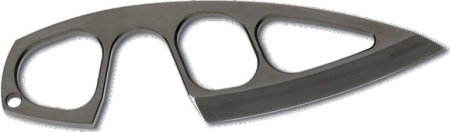
Anyway, in the course of looking, I ran across the Böker MA-2, designed by the Miltner Adams Company: It's not a tactical folder, but it is what I consider to be a beautiful knife. And its list price is just under US$30. I got one, treated it with a Sentry Solutions Marine Tuf-Cloth, and stashed it away in my collection. (I don't leave my knives quite MiB, as I almost always treat them with a Tuf-Cloth.)

I still need to resolve what to do for the tactical folder.

Assuming Free Disposal

Saturday, 23 May 2009

I needed two rubber buttons (to replace broken buttons on shirts). The least expensive way for me to acquire them was to buy a gross (144) of them, for $3.49 (including shipping).

Personal Miscellany

Thursday, 7 May 2009

The toe that I injured more than six weeks ago still hurts when flexed in some ordinary ways. I'm fairly sure that I broke the thing. According to what I've read, it may take up to a year to completely heal.


Recently, two different people at different places on different days have asked me about my having a foreign accent. As far as I'm concerned, I have a very generic American accent. The Woman of Interest and I speculate that the lack of more precisely identifiable regionalization is what has people wondering about my being from elsewhere. That is to say that I cannot be placed from my speech as from the South, Northeast, Midwest, or whatever.

I don't think that I was ever much inclined to adopt regionalisms. For example, my mother had a very strong Arkansan accent when I was a child, my father has a Missouri twang, and from some time in my fourth year until some time in my seventh, my family lived in North Carolina; yet it was noted that neither my brother nor I developed southern accents. Much later, I became very consciously deliberate in selecting the characteristics of what amounts to my personal accent. I wasn't interested to appear to be from a particular place or of a particular social standing; I was interested in things such as clear enunciation and as respect for the language.

A Slice with Ockham's Razor

Friday, 1 May 2009

Working on that less formal explanation of my paper has paid another dividend.

The model in the paper has involved six propositions, which function like axiomata, specifically about choices concerning lotteries. I have known for some time that these weren't orthogonal — that there was overlap amongst what they said. It is at best unfortunate to have that sort of redundancy in foundational propositions. But I'd not seen how to reduce it.

This morning, after describing those propositions less formally, and then considering what to say about the theoremata that follow, I started to see how to turn one of those propositions into a theorem. After a bit of musing and fretting, I've effected the change.

Tossing the Fudge into the Trash

Friday, 1 May 2009

Yester-day, as I was in the course of writing-up a somewhat less formal discussion of the ideas in my decision-theory paper, I reälized that I had fudged something important in that paper.

More specifically, I had erroneously treated an important property of one relation as ex definitione. That property does follow from the combination of the definition with some propositions in the paper, but it's not a fully observable property, whereäs I had tried to make each of the relations as observable as was possible, even at the cost of using somewhat cluttered definitions.

I was, unsurprisingly, very unhappy with the reälization. The confusion had been an act of incompetence on my part, in an area where competence is quite important to me. It meant that I had increased the potential burden upon those who have been or will be kind enough to check-over that work. And I didn't immediately know how much work I would have to do to repair the model.

As to the last, when I buckled-down and started the revision, it proved to be fairly easy. I removed the mistaken assertion in the discussion of the definition, and inserted a quick proof of the property amongst the theoremata.

Had the error not been caught before the paper were submitted to a journal, it might well have caused the paper to be rejected. A referee might have been bright enough to pick-up on the mistake, but (for various possible reasons) not seen that it weren't truly fundamental to the work.

One lesson that is reïnforced by this experience is the value, for one's own understanding, of explaining ideas to others.

Rats!

Tuesday, 28 April 2009

Yester-day, I found a rat's nest under the hood of my car. Literally.

I visited my parents in Tucson from late March until last Tuesday. I parked outside, just off their drive-way, and didn't use my car very much during that time. They live far east of the city center, out amongst the cactus, gilla monsters, and pack rats. I spotted the occasional pack rat under my car, but thought very little of it.

On my way home, I was pulled-over by an officer of the Arizona Highway Patrol, because my passenger-side head-light was out. (He was simply concerned that the problem be addressed, and gave me a written warning rather than ticketting me.) I went to an automotive store on the next day or the day after that, and bought new bulbs. But, when I popped the hood to replace the bulb, I found that the wires to the bulb were frayed and broken. There was nothing there to bang-around. The Woman of Interest suggested that they'd been chewed by a mouse. Rodent damage seemed plausible, and I couldn't think of a good rival explanation. Anyway, I decided that the best way to effect a repair was with a new connector and some butt connectors (metal sleeves, which are in turn ensleeved in plastic, and which are crimped to join wires or cables).

Apparently, I was operating with a sort of tunnel vision when I discovered the chewed wires. Although the rat's nest was quite big, I didn't spot it, sitting on the engine behind the valve cover, until yester-day, as I was effecting the repair. The nest was built of twigs, sticks, and some soft fibrous material. I was puzzled about why I hadn't had an engine fire, until I reälized that the soft fiber was produced by shredding swatches of the hood insulator. That rat really did considerable damage.

None-the-less, its actions weren't malicious, and I rather hope that it either wasn't in the car at all when I was driving, or leapt out before I was going more than a few miles per hour. Otherwise, the pack rat almost certainly was cooked to death or was killed when it hit the pavement. Had it cooked, I probably would have found a body. And if the nest was built between my previous use of the car and when I was loading it to go home, then the rat probably fled as the car shook from that loading.

Grey Light at the End of the Tunnel

Friday, 24 April 2009

The current version of my paper operationalizing and formalizing preferences that are not totally ordered can probably be pushed out the door now. I'm running or going to run it past two more academic economists whom I know before I submit it to a journal, but that's just pronounced caution, and more concerned with the quality of the exposition than with that of the ideas themselves.

Unfortunately, while I'm reasonably sure that the work is correct, I no longer have a gut sense that it's important. Intellectually, I see this lack of such a sense as stemming from a confluence of three things.

The first two are my extended efforts to understand and to communicate matters clearly; these efforts result in those matters now seeming very clear and thus seeming rather obvious to me. I have to remind myself that it was all very murky when I began.

But, additionally, through my life, I've repeatedly had the experience that I just don't feel the significance of completed work. I'm not sure why. Perhaps it's just constitutional anhedonia. I do know that things such as ceremonies and celebrations don't help.


I've cobbled-together a sort of cheat-sheet for some of my readers who might not be familiar with some of the notation, mathematical notions, and economics jargon that I use in the paper; I'll make it openly available when I make the paper itself more openly available. (In the mean time, anyone with access to the paper who wants a copy of the cheat-sheet should let me know.) At some point, I hope to write-up a sort-of informal translation of the ideas of the paper into far less technical language.

For he is the Man of the Hidden Face!!!

Monday, 20 April 2009

While I'm trying to get readers to visit the Pictorial Arts I'd like to point to a specific pair of entries, The Great Comic Book Heroes part 1 and part 2, from 9 February.

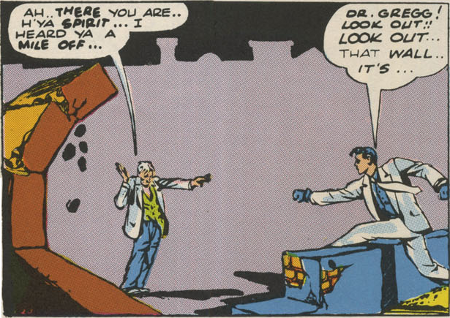
It was in Jules Feiffer's book, The Great Comic Book Heroes, that Buchanan and later I first encountered an untitled story by Will Eisner earlier published in the spring of 1941. Buchanan writes It showed me what comics could be. My reäction had been much the same. I'd seen some awfully good comic book art before I saw this story — Steranko's three issues of Captain America come immediately to-mind — but I'd just never seen anything like this. My sense of what a comic book could be was deeply changed.

(Later, I found more stories by Eisner, and discovered to my great dismay that Eisner had given the character of the Spirit a black side-kick who was depicted in a profoundly racist manner. I'm glad that that side-kick didn't appear in this story, so that my first exposure to work of such quality wasn't blighted.)

The Pictorial Arts

Monday, 20 April 2009

Last year, I posted a 'blog entry recommending that my readers visit Golden Age Comic Book Stories, where are found not just golden age comic book stories, but more generally a great many wonderful examples of the art of illustration.

By way of Golden Age Comic Book Stories, I've been led to another 'blog, the Pictorial Arts, to which I also want to give a strong recommendation. Like Golden Age Comic Book Stories, the Pictorial Arts features many examples of outstanding illustration. The Pictorial Arts differs in various respects. Most strikingly, its owner, Thomas Haller Buchanan, writes something of what the illustrations (and often the illustrators themselves) have meant to him, the rôle that they have played in his life.

Buchanan is himself a professional artist of superior ability; one gets to see some of his work

[portrait in chalk by THB]
image used with kind permission of artist
at another of his 'blogs, People Skills. At the Pictorial Arts he says little about that ability or about that work, but instead writes about work of other artists that he has found compelling, from the time that he was a small child up to the present. One may see not what he can produce, but that he could and can see as an illustrator would, and what he saw and sees that made him aspire to become an artist himself.

One of the things that I respect about Buchanan is that he posts about the work that he appreciates, regardless of its social standing. But what has me actually following his the Pictorial Arts is that I like so much of the work to which he directs attention. Some of it is by artists whom I have long admired; in some cases it is work that I too first encountered as a child and which made a strong impression on me. In other cases, I'd not seen it at all before I found it in his 'blog.

Tweak of the Weak

Friday, 17 April 2009

In ordinary decision theory, the name weak preference is used for a relation that could be defined as the complement of the inverse of strict preference, or as the union of strict preference with indifference. In ordinary decision theory, these two are equivalent. Typical symbols used for this relationship are , and .

In my paper, I noted the conventional conception of weak preference as the aforementioned union; later, I defined it for my purposes such that

(X1X2) ≡ [{X1} ⊆ C({X1, X2})]
which is the complement of the inverse of strict preference.

Well, I've decided that I was just asking for trouble using that name and that symbol, because people would have trouble not thinking of it as the union of strict preference with indifference, and thence think that a distinct relation of indecision is precluded a priori. So I've switched to the name non-rejection and the symbol .

There will probably still be people who ask how this relation differs from that of weak preference, but that will be more an expression of their cleverness than of their confusion, and it will be easier to offer an explanation how the relation could be seen as weak preference, how it should not be seen as weak preference. (I may try to squeeze some preëmptive discussion into the paper, though I am bumping-up against size limits.)

Addendum (2009:04/18): I added a preëmptive discussion, so that even fewer people will get confused.