Archive for the ‘public’ Category

Brushes with Death

Thursday, 31 July 2008

As a result of contemplating eventual replacement of my shaving brush, I have been looking into how three sorts of animal hair are harvested — badger, boar, and horse.

A type of badger bristle is used for the finest sorts of shaving brushes, but these bristles are got from killed badgers. As much as I would like a high-quality shaving brush, I do not want to do anything to promote the killing of badgers. (Their populations could be controlled without slaughter.)

Other shaving brushes (like some hair brushes) are made with boar bristles. Most boar bristles seem to come from killed boars, but there is actually at least one firm that shears living boars to harvest their bristles. I'll look into brushes from such a source.

(I can also get a synthetic-bristle shaving brush, though by all accounts these are inferior to natural-bristle brushes.)

I was under the impression that some shave brushes were made with horse hair, but seem to have been mistaken on that score. [Up-Date (2 August): I have indeed found some horse-hair shaving brushes.] In any event, I learned that some horses are raised for the hair of their manes or tails, which is clipped, but that most horse hair comes from slaughtered horses.

Under My Feet

Tuesday, 29 July 2008

I was asleep when the 'quake hit the Greater Los Angeles Area late this morning (I'd gone to sleep less than four hours earlier), but when the shock reached Hillcrest, it woke me up. First there was a little rattling, then more aggressive shaking.

Yet I didn't hear any change in the activity in front of the building. People didn't raise their voices, and so forth. And, after I was out-and-about, I over-heard other people saying or implying that they felt nothing. My guess is that my apartment shook as much as it did because it is on the third floor, and the building amplified the oscillations.

I was glad that the 'quake itself wasn't stronger at its epicenter. Frankly, I'd be pleased if the Los Angeles area would just have a series of 'quakes of that magnitude, until the energy trapped in the fault were spent, rather than some eventual Big One.

This Bud's for Shrew

Tuesday, 29 July 2008
Tree-shrew is heavyweight boozer from the BBC
Nectar from the flower buds of the bertam palm is fermented to a maximum alcohol content of up to 3.8%.

Each bud is a miniature brewery, containing a yeast community that turns the nectar into a frothy beer-like beverage.

Yet the animals, which are about the size of a small rat, do not seem to get drunk at all, researchers say.

Nicht Sehr Gut

Tuesday, 29 July 2008

I have been reading Gut Feelings: The Intelligence of the Unconscious by Gerd Gigerenzer. Gut Feelings seeks to explain — and in large part to vindicate — some of the processes of intuïtive thinking.

Years ago, I became something of a fan of Gigerenzer when I read a very able critique that he wrote of some work by Kahneman and Tversky. And there are things in Gut Feelings that make it worth reading. But there are also a number of active deficiencies in the book.

Gigerenzer leans heavily on undocumented anecdotal evidence, and an unlikely share of these anecdotes are perfectly structured to his purpose.

Gigerenzer writes of how using simple heuristics in stock-market investment has worked as well or better than use of more involved models, and sees this as an argument for the heuristics, but completely ignores the efficient-markets hypothesis. The efficient-markets hypothesis basically says that, almost as soon as relevant information is available, profit-seeking arbitrage causes prices to reflect that information, and then there isn't much profit left to be made, except by luckunpredictable change. (And one can lose through such change as easily as one might win.) If this theory is correct, then one will do as well picking stocks with a dart board as by listening to an investment counselor. In the face of the efficient-markets hypothesis, the evidence that he presents might simply illustrate the futility of any sort of deliberation.

Gigerenzer makes a point of noting where better decisions seem often to be made by altogether ignoring some information, and provides some good examples and explanations. But he fails to properly locate a significant part of the problem, and very much appears to mislocate it. Specifically, a simple, incorrectly-specified model may predict more accurately that a complex, incorrectly-specified model. Gigerenzer (who makes no reference to misspecification) writes

In an uncertain environment, good intuitions must ignore information

but uncertainty (as such) isn't to-the-point; the consequences of misspecification are what may justify ignoring information. It's very true that misspecification is more likely in the context of uncertainty, but one system which is intrinsically less predictable than another may none-the-less have been better specified.

I am very irked by the latest chapter that I've read, Why Good Intuitions Shouldn't Be Logical. In note 2 to this chapter, one reads

Tversky and Kahneman, 1982, 98. Note that here and in the following the term logic is used to refer to the laws of first-order logic.[1]

The peculiar definition has been tucked behind a bibliographical reference. Further, the notes appear at the end of the volume (rather than as actual foot-notes), And this particular note appears well after Gigerenzer has already begun using the word logic (and its adjectival form) baldly. If Gigerenzer didn't want to monkey dance, then he could have found an better term, or kept logic (and derivative forms) in quotes. As it is, he didn't even associate the explanatory note with the chapter title.

Further, Gigerenzer again mislocates errors. Kahneman and Tversky (like many others) mistakenly thought that natural language and, or, and probable simply map to logical conjunction, logical disjunction, and something-or-another fitting the Kolmogorov axiomata; they don't. Translations that presume such simple mappings in fact result in absurdities, as when

She petted the cat and the cat bit her.

is presumed to mean the same thing as

The cat bit her and she petted the cat.

because conjunction is commutative.[2] Gigerenzer writes as if the lack of correspondence is a failure of the formal system, when it's instead a failure of translation. Greek δε should sometimes be translated and, but not always, and vice versa; likewise, shouldn't always be translated as and nor vice versa. The fact that such translations can be in error does not exhibit an inadequacy in Greek, in English, nor in the formal system.


[1]The term first-order logic refers not to a comprehensive notion of abstract principles of reasoning, but to a limited formal system. Perhaps the simplest formal system to be called a logic is propositional logic, which applies negation, conjunction, and disjunction to propositions under a set of axiomata. First-order logic adds quantifiers (for all, for some) and rules therefor to facilitate handling propositional functions. Higher-order logics extend the range of what may be treated as variable.

[2]That is to say that

[(P1P2) ⇔ (P2P1)] ∀(P1,P2)

The Lady Vanishes

Thursday, 24 July 2008

Speaking of LJ, the behavior of legomymalfoy, the member-elected representative to the Advisory Board, is raising eyebrows and ire. Upon her election, she cut herself off from those not on her Friends-list. adameros is polling members about how they feel about this behavior.

Driven to Destruction

Thursday, 24 July 2008

Yester-day or the day before that, AMD made available a new version of their Linux driver for the graphics adapter in my note-book computer. I was pleased, as I hoped that it would eliminated the logging-out problem that I've been having. (This problem did not go away when I up-dated my driver on 6 July.)

Well, things have changed with the new driver, but seemingly for the worse. I'm still logged-out when using Firefox with some webpages, but now the display ends-up blanked and effectively disabled, so that I have to completely restart the system. (Perhaps the frequency of being logged-out has been reduced.)

Oh well. I will hope that the next driver up-date resolves the problem.

Everybody Wins!

Wednesday, 23 July 2008

Dr Pepper Snapple Group has been promoting Dr Pepper with a sweepstakes. Entry codes are obtained from bottle caps or packages. The promotion claims 1 in 6 WINS!.

The Woman of Interest has ostensibly won five times, but the award has each time been an advertisement — two Dr Pepper screensavers and three Dr Pepper wallpaper graphics.

Which brings me to СУП.

As previously noted, they are eliminating Basic Accounts, under the pretense of responding to popular demand. Basic Accounts will be replaced with accounts such that advertising is to be presented to holders or to visitors, though the precise details might not yet be decided.

Perhaps СУП should copy a page from the Dr Pepper Snapple Group playbook! СУП just needs to stop referring to these advertisements as such, and start calling them prizes!

G_d knows that lots of LJ members would thank mustela prima for the bounty.

Babycakes

Tuesday, 22 July 2008

David's Coffee Place is apparently now replaced with Babycakes. [image of the front exterior of Babycakes] An expert came and inspected the piano, which is being sold.

Again, I regret these changes, though in most cases the new owners may be making the best choices available to them.

Meanwhile, a block-and-a-half north, a place named Mille Feuille is scheduled to open in August. They advertise themselves primarily as a chocolatier and bakery, but apparently will be offering tea and sandwiches as well. Since Babycakes has been envisioned as having more in the way of desserts and baked goods than David's Coffee Place, and as more of a restaurant, the appearance of Mille Feuille may be a problem for them. (There are many other restaurants in the immediate area, but Mille Feuille seems to be closer in intended product mix.)

Addendum (23 July): The piano that is being sold is a baby grand (in fact, an especially small baby grand, but with a good lower range). I was informed last night that Babycakes has an upright piano that they will be putting into service. (The notion being that it will take less floor space.)

Things Fall Apart

Tuesday, 22 July 2008

I've been looking at background discussion on Wikipedia, and it seems to be doing a fair job of tearing itself to shreds.

There is a set of intertangled disputes involving two camps. The Request for Arbitration to which I earlier linked seems to be illustrative; it's certainly not the only example. See also Wikipedia:Administrators' noticeboard/Incidents/Tony Sidaway and the resulting request for more arbitration. [(2008:07/24) I have up-dated the previous link.]

The requests for arbitration between these camps don't seem to be producing actual arbitration, even when the Arbitration Committee had earlier agreed to take a case. The Arbitration Committee is beginning to be hammered for failing to reach any decisions in that case to which I earlier linked. One member of the Arbitration Committee is trying to get the others to agree to just dismiss the case, but the Committee isn't even deciding to flee from responsibility. (There are grumblings that the Arbitration Committee should be abolished if it does flee.)

Now, as to that case, I'm not sufficiently informed to condemn all of the parties, nor to exonerate any of the parties, but I am sufficiently informed to identify the behavior of some of the parties as egregious. And those parties all happen to be in one of those two camps, which camp has strongly allied itself with Jimmy Donal Wales — that's right, the Jimbo Wales who provided the funding that launched Wikipedia, the Jimbo Wales who reserved the general right to over-turn any decision of the Arbitration Committee.

If the Arbitration Committee fails to come down on those parties hard, then those parties are going to become even more out-of-hand, and the committee will lose a lot of respect all-around (though one camp may prize them as fine toad-eaters). On the other hand, if the Arbitration Committee does come down on those parties, then they may alienate Jimbo Wales, who may even over-rule their decisions or so weaken the measures taken that they become not so much meaningless as ironic.

And tell me I'm your own

Monday, 21 July 2008

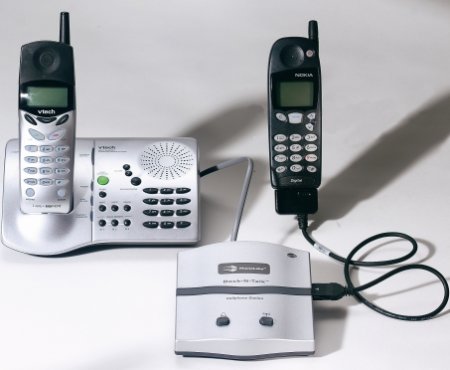
I don't recall 28bytes mentioning the PhoneLabs Dock-N-Talk: image of PhoneLabs Dock-N-Talk This device intermediates between a subscriber set designed for use with a land-line and a cell-phone,
image of PhoneLabs Dock-N-Talk so that the land-line set can be used to place and receive calls by way of the mobile phone. (The land-line set can remain connected to the land-line, and even put a cellular call on-hold while taking a land-line call. To connect the Dock-N-Talk to a cell-phone hand-set, one needs either an adapter cable (which will vary based upon the hand-set) or the Bluetooth module.)

Now, many people might ask

Uhm, why?
The answer that has potential relevance for me is that I have a collection of vintage phones that I would like to have in service in some future home (and the Woman of Interest has a red WECo Model 500 that she probably won't want to retire to the attic), but I'm not entirely sure that I will have a land-line. It would seem less frivolous to buy an adapter than to lease a land-line connection just to be able to put the vintage phones to use.

Now, the product page and the FAQ make no mention of pulse dialing, and my presumption is that the Dock-N-Talk requires tone dialing from the land-line set. But there are commercially available devices that can be placed in-line with a pulse-dialing phone to convert the pulses to tones; and there are other devices, which can be held to the microphone to produce the sounds for tone-dialing.

