Archive for the ‘commentary’ Category

Whispers between the Lines

Saturday, 17 October 2009

There is a passage[1] in Locke's Essay Concerning Humane Understanding of which I took special note from the first time that I read it:

5. That men should keep their compacts is certainly a great and undeniable rule in morality. But yet, if a Christian, who has the view of happiness and misery in another life, be asked why a man must keep his word, he will give this as a reason:—Because God, who has the power of eternal life and death, requires it of us. But if a Hobbist be asked why? he will answer:—Because the public requires it, and the Leviathan will punish you if you do not. And if one of the old philosophers had been asked, he would have answered:—Because it was dishonest, below the dignity of a man, and opposite to virtue, the highest perfection of human nature, to do otherwise.

The reason that this passage stood-out and stands-out for me is that it contains a fundamentally sympathetic statement of a godless morality, and indeed fairly clearly exhibits the parallel between the might of G_d making ostensible right for the Christian, and the might of the State making ostensible right for the Hobbsean.[2] Locke's philosophy, epistemological and ethical, is heavily informed by a belief in a loving G_d, yet here Locke seems to reveal sufficient subtlety to do rather well without that G_d.

There's another striking passage[3] in that same work:

50. If we look upon those superior beings above us, who enjoy perfect happiness, we shall have reason to judge that they are more steadily determined in their choice of good than we; and yet we have no reason to think they are less happy, or less free, than we are. And if it were fit for such poor finite creatures as we are to pronounce what infinite wisdom and goodness could do, I think we might say, that God himself cannot choose what is not good; the freedom of the Almighty hinders not his being determined by what is best.

51. A constant determination to a pursuit of happiness no abridgment of liberty. But to give a right view of this mistaken part of liberty let me ask,—Would any one be a changeling, because he is less determined by wise considerations than a wise man? Is it worth the name of freedom to be at liberty to play the fool, and draw shame and misery upon a man's self? If to break loose from the conduct of reason, and to want that restraint of examination and judgment which keeps us from choosing or doing the worse, be liberty, true liberty, madmen and fools are the only freemen: but yet, I think, nobody would choose to be mad for the sake of such liberty, but he that is mad already. The constant desire of happiness, and the constraint it puts upon us to act for it, nobody, I think, accounts an abridgment of liberty, or at least an abridgment of liberty to be complained of. God Almighty himself is under the necessity of being happy; and the more any intelligent being is so, the nearer is its approach to infinite perfection and happiness. That, in this state of ignorance, we short-sighted creatures might not mistake true felicity, we are endowed with a power to suspend any particular desire, and keep it from determining the will, and engaging us in action. This is standing still, where we are not sufficiently assured of the way: examination is consulting a guide. The determination of the will upon inquiry, is following the direction of that guide: and he that has a power to act or not to act, according as such determination directs, is a free agent: such determination abridges not that power wherein liberty consists. He that has his chains knocked off, and the prison doors set open to him, is perfectly at liberty, because he may either go or stay, as he best likes; though his preference be determined to stay, by the darkness of the night, or illness of the weather, or want of other lodging. He ceases not to be free; though the desire of some convenience to be had there absolutely determines his preference, and makes him stay in his prison.

Now, regardless of whether we agree that a being can be free and yet determined by something (not, as I believe, a contradiction if that something is internalized in the determined being), the fact remains that a G_d of this sort is more law-driven than many would conceive G_d to be.

Anyway, what brings all this to mind is that, lately, I have been reading (albeït in somewhat desultory manner) The Courtier and the Heretic: Leibniz, Spinoza, and the Fate of God in the Modern World by Matthew Stewart. Chapter 15 (The Haunting) contains a section entitled Stopping Locke, which ends thus

Locke's vague conjecture that matter might be able to think, of course, is Spinoza's avowed doctrine. […] Leibniz's magesterial refutation of the founder of British empiricism, in brief, is a covert assault [Spinoza]. Furthermore, [in Leibniz's mind] Locke — like Descartes before him — is really just a feeble imitation of Spinoza: he leaves in doubt that which his dark master pitilessly destroys.

[…]

Leibniz's unstated intuition that Locke was something of a Spinozist, incidentally, is probably more insightful than is generally allowed in modern interpretations of the great empiricist's work. Locke wrote much of his Essay while living in exile in Holland from 1683 to 1688, during which time he purchased all of Spinoza's works and mingled in circles that included some suspiciously freethinking characters. Furthermore, the parallels between his work and that of Spinoza extend well beyond those suggested by Leibniz. To be sure, as a conciliation-minded member of the Christian establishment, Locke toned down or obfuscated some of the more radical implications of his Spinozism — a task for which his inimitably wobbly prose was particularly well suited.

I would hardly agree that Locke's prose were wobbly, let alone that it were inimitably so; in fact, I don't think that a person given to wobbly writing would be capable of the sort of perspicacious thinking that got Locke as far along as his did. But the point remains that some of what I noted in Locke, such as in the two paragraphs of the Essay that I quoted, demonstrates that Locke represented some of the same tendencies as did Spinoza. Any notion that Locke borrowed heavily from Spinoza would have to confront what was already indicated by Locke's background and writings before he fled to Holland (and, earlier, before Spinoza had published anything); none-the-less, it would hardly be surprising if Leibniz indeed feared that Locke were in effect an agent of Spinoza's philosophy.


[1] Book I Chapter II ¶5, in the 1894 edition edited by Alexander Campbell Fraser (which is the edition that I read).

[2] The Hobbsean will assert that the State makes possible a manner of living whose goodness is not itself derived from the dictates of the State. Many Christians would want to make a similar claim for the goodness of the manner of living made possible by G_d. However, if pressed, most of them would not answer as did Ευθύφρων in the fable by the old philosopher Πλάτων; rather, they would feel compelled to hold that not simply instances of goodness but the distinction of goodness were creäted by the power of G_d. But Locke himself proves an apparent exception to my characterization. (See above.)

[3] Book II Chapter XXI ¶50-1.

Isn't It Good? Norwegians Would!

Tuesday, 13 October 2009

Now here's a nice bit of presumptuous silliness:

Mr Lundestad [secretary of the Norwegian Nobel Committee], however, hopes Americans take pride in the award as recognition of the much higher confidence in America in almost all parts of the world since Mr Obama was elected.

Imagine how the typical European would reäct to the claim that they should take pride when some European figure is given a pat on the back by a group of American conservatives or neo-conservatives.

If one is still trying to understand what the H_ll happened, one might find useful:

Building upon a Cloud, Crashing Thence to Earth

Tuesday, 13 October 2009

Years ago, core computing tasks were performed on shared mainframe computers, with individual users assigned terminal devices to communicate with the mainframe computer. Some of the terminals were smart, and able to enhance the interaction. Notably, the CTC Datapoint 2200 was in fact itself a programmable computer (in production five years before Steve Wozniak's Apple I), and was the direct ancestor of the x86 computers of to-day. But few of smart terminals themselves ran any code other than to provide interface for communication with the mainframe. (And the dumb terminals ran no applications.) There were efforts to get the general population using mainframes by way of terminals located in their homes, but these efforts enjoyed limited success.

Then the idea of personal computers caught hold, so that a large share of the population indeed computed at home or in the office. But the computing itself was primarily done at basically the same physical location as was the user. It was possible to add some communications hardware to the computer, and then use it as a terminal device, but most of the tasks that had previously been performed on a mainframe were now being performed locally.

When the 'Net came into wider use, some people started having the thought that perhaps it would be an advancement if principal computing tasks were moved onto the Internet, which is to say onto serving computers that were available by way of the 'Net. Unsurprisingly, I see this as a return to an earlier, previously unpopular model.

Now, sometimes, changes in an infrastructure can breathe new life into essentially older technologies; and one shouldn't reject this idea of moving back to locating core computing on remote machines simply because we had previously reduced its relative use. But I find it a signally unappealing idea, because it removes the independence of personal computing. I very much like the fact that I can do everything without communicating except communication itself. I have local applications for text processing and for type-setting, for multimedia generation, for mathematical analysis, and for programming. For these things, I don't have to rely upon a connection to the 'Net nor upon someone's server.

While there are some tasks that might be better performed by a network of distributed service, there is no particular reason for handing responsibility to such a network for mundane tasks that users could easily be performing with local equipment. And the introduction of the opaque buzzword cloud to refer to distributed service on the Internet does nothing but get my back up.

Anyway, I was prompted to ventilate by this story:

T-Mobile Sidekick users have had things such as contact information and photos stored on the cloud, which in this case is to say some servers that T-Mobile has leased from a division of Microsoft, which division is aptly named Microsoft/Danger. Well, the servers weren't properly backed-up, they crashed, and most or all that they held is just … gone.

[Up-Date (2009:10/15): Microsoft has now largely reversed itself, declaring we have recovered most, if not all, customer data for those Sidekick customers whose data was affected by the recent outage. We rebuilt the system component by component, recovering data along the way.]

Booby Prize

Friday, 9 October 2009

The short-term result of the Nobel Committee giving the Peace Prize to President Obama will probably be to increase his political capital in some amount (in a context where polls shows his domestic approval trending downward and at or below 50%). In the long-run, this award will prove damaging to popular American perceptions both of Europe and of the Democratic Party.

American perceptions of Europe will suffer, because the only distinctive objectives had by President Obama which enjoy majority support are objectives at which he will not succeed. And American perceptions of the Democratic Party will suffer because it will be seen not simply as seeking the wrong things but as doing so in alliance with alien forces.

Sand in the Gears

Thursday, 8 October 2009
Saudis ask for aid if world cuts dependence on oil from the AP

Saudi Arabia has led a quiet campaign during these and other negotiations — demanding behind closed doors that oil-producing nations get special financial assistance if a new climate pact calls for substantial reductions in the use of fossil fuels.

Very shrewd. The real result of this demand will be to make it more difficult for states to agree to limit emissions, which in turn will allow the Saudis to sell more petroleum. (Nor will they take much blame for failure to reach agreement, as that would interfere with Yank-bashing.)

Franken Does Truth a Service

Thursday, 8 October 2009
Franken gets testy over statistics by Eric Roper of the Star Tribune

The senator spent the bulk of his time attempting to debunk the witness, particularly a statistic in his testimony that employees have a 63 percent chance of prevailing in arbitration compared to 43 percent in litigation.

[…]

De Bernardo eventually conceded that he did not know whether $50 would be considered "prevailing" in the statistic,[…].

While Franken has at times resorted to worse intellectual dishonesty than in this case he exposes, here he is right on the mark. As Franken's line of questioning and the answer that it elicts show, the statistic in question tells us virtually nothing about whether the outcomes of arbitration would be considered equally or more favorable to employees than are the outcomes of litigation. It is, in other words, a garbage statistic.

Firms are entitled to require arbitration as a condition of doing business with them, but those who deal with these firms are likewise entitled to require that there be no such imposition as their own condition of doing business.

Quite Different

Thursday, 8 October 2009

Consider two propositions:

  • The first is that markets are smart, to the extent that they cannot be tricked into anything unless one carefully hides most or all of the contrary evidence.
  • The second is that, left unregulated, markets produce some best possible outcomes.
These aren't at all the same proposition. On the one hand, something can be hard to deceive, yet work at purposes contrary to those that one favors. On the other hand, a mechanism can be vulnerable to some sorts of disruption but, in the absence of that disruption, perform some task well. I'm not saying that the propositions are contrary; they could be simultaneously true; none-the-less, they're plainly not identical.

The run-up to the latest economic crisis seems to have been founded in no small part by a confusion of these two distinct propositions. The Bush Administration represented itself — and may well have considered itself — free market, in-so-far as it expected considerable resilience on the part of the market in the face of remarkable levels of state borrowing and considerable other interventions (compassionately conservative or kleptocratic). And Alan Greenspan, who surely considered himself a believer in laissez faire, is these days explaining his optimistic proclamations from before the crisis as stemming from a failure to reälize that investors would not recognize that a boom could not last forever, to which lack of recognition he also attributes the crisis, as if irrational exuberance were simply a Keynesian animal spirit, rather than a product of things such as lending regulations and Federal Reserve interest rate policy.

Meanwhile, many of the Keynesians, socialists, and pragmatic technocrats (long-standing or born-again) are arguing that the fact that the market could be fooled shows that markets aren't clever and that thus various sorts of interventions are needed, as if any defense of free markets must hang upon a belief that markets are simply too clever to be fooled. Left unaddressed is whether the confusion were endogenous or brought on by state intervention, whether those prior interventions that may have been the cause of the confusion produce actual benefits worth the costs of that confusion, and whether more intervention would produce a more clever system or a less clever system.

In fact, there are various long-established free-market schools of thought that attribute economic crises to a propensity of state intervention to fool economic participants. For example, it is difficult to distinguish to what extent interest rates reflect the supply and demand of private savings for future consumption, and to what extent they are an artefact of central bank intervention for other purposes. In the face of Federal Reserve manipulation of interest rates, the market will not be sufficiently smart to see what the price of loanable funds should be, and therefore will almost certainly build too much or too little for the future.

Casa di Bafflement

Saturday, 19 September 2009

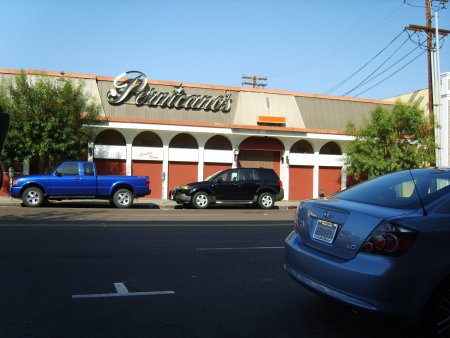
One of the oddities of Hillcrest manifests itself as this building front: [image of unlabelled building] It's right in the middle of the block on the east side of 5th Avenue, between Robinson Avenue and University Avenue. The doors have been closed and locked every time that I've passed.

Walk around to the east side of the block, on 6th Avenue, and you'll find a building and parking lot with signs for Pernicano's and Casa di Baffi. (The name of the latter means House of the Mustaches.) [image of Pernicano's / Casa di Baffi] [image of Pernicano's / Casa di Baffi signs] The building itself is labelled Pernicano's. [image of Pernicano's It is always closed. The parking lot [image of Pernicano's / Casa di Baffi parking lot] is always fenced-off and unavailable.

All told, this is a pretty big chunk of a city block. [overhead image of city block, highlighting the aforementioned properties] Hillcrest has various idling properties right now, but, actually, these particular properties have been idling since 1985!

I believe that the building on 5th Avenue was Casa di Baffi, but I wasn't in San Diego back in '84. In any case, the properties belong to George Pernicano. He operated two restaurants there from 1946 until 1985. Pernicano's was apparently quite a hot-spot, with movie stars and celebrity athletes visiting regularly. Then he shut the restaurants down, and refuses to do anything with the property.

Various explanations — some speculative, some perhaps informed — are offered for why Mr Pernicano keeps these properties idle.

Search the web, or ask some of the merchants in Hillcrest, and you'll read or hear a lot of complaining about Pernicano. Some of it is honest; some of it self-serving posturing. Many merchants would like active businesses on these lots; some parties, at least in good times, would like to have the properties for their own direct use; a lot of people would like local parking to be increased, as it is a real problem.

My own view starts with the point that the properties belong to Pernicano. People can make polite suggestions — and some indeed confine themselves to such — but Pernicano ought to reject sanctimonious demands out-of-hand. As to parking, if successful businesses were again operating out of the two buildings, increased demand for parking would consume that now unused lot. I don't see any other landlords preparing to tear down a building to make room for a parking lot. I think that the parking issue is a wash.

But I do think that Mr Pernicano needs to attend to some building maintenance very soon. [roofing tiles on 5th Avenue building] Some of those roofing tiles on the 5th Avenue building are working loose. Results could be pretty dire if one fell and hit a pedestrian.

GoDaddy BackOrder Blues

Friday, 18 September 2009

Some years ago, Go Daddy added a back-order service whereby a domain already registered by another party would be monitored and, should its registeration lapse, the domain would be registered in the name of the purchaser of the service.

Some time after that, Go Daddy added an auction service. And, when registration lapses for which Go Daddy is the registrar, then duiring the grace period (42 days in the case of Go Daddy) Go Daddy itself puts the domain up for auction; the auction ends well before the grace period, and the auction results are cancelled if the prior registrant renews before the end of the grace period.

A registrant seeking to have a domain appraised might simply let the registration lapse, watch the auction, and then register before the end of the grace period. A late registration requires a higher fee, but that difference could be viewed as the cost of appraisal.

Now. here's where it gets ugly. Go Daddy holds such auctions even if there is a prior back-order. They hold the auctions even if the domain had a different registrar when the back-order was placed, but then switched to Go Daddy. They hold the auctions even if the back-order was placed before they had an auction service. If the domain should be bid to anything above an opening bid of US$10, the purchaser of the back-order must either pay more or let the domain go to some other party.

A Go Daddy back-order on a domain is worse than useless to its buyer if the domain may be expected to be registered with Go Daddy at the time whenever registration lapses. If the domain is sufficiently attractive that a back-order would be useful without an auction, then there will be competitive bidding in an auction.

Now, I'm sure that Go Daddy sent a notice that the old back-orders were going to be subjected to the new protocol, and that refunds were offered. But few if any customers would have understood the implications of a change, otherwise there would have been a lawsuit that Go Daddy would have lost, as simple refunds wouldn't have covered the economic loss avoidably being placed on these customers.

Uhm, No

Wednesday, 16 September 2009

I recently read someone defending socialism on the ground that socialism has the same root as does society. Well, I don't object to society. And I venture to guess that she doesn't object to fathers, yet I go further to guess that she does object to what's called patriarchy. One mustn't over-reach with etymology, with dear old dad, nor with society.

I've previous explained the economic calculation problem of socialism: Rational allocation of resources requires trade-off signals that reflect as much relevant information as practicable. Most of the relevant information is highly decentralized, and some of it (such as the expectations and preferences of participants) is intrinsically so. A market brings that information into play by way of prices (trade-off signals) developed by the give-and-take of would-be consumers and of would-be sellers. Socialists haven't developed an alternative; they correct the market only at the cost of over-all misallocations with their own costs in human welfare.

This point is as true in the delivery of health care as anywhere else. Almost everyone agrees that American health-care delivery is in appalling shape, but there are those who ignore that the problems have grown as state interventions have increased. Commentators frequently note that costs have exploded in the last fourteen years, but then most of these commentators are silent on the fact that the period followed upon the last round of reforms. Of course, the period before those reforms wasn't itself some sort of golden age; the reforms were effected because many things were seen to be worse than once they were, and getting worse still. But, again, due attention was not paid to the rôle of prior state intervention in effecting that worsening. This routine of blaming what remains of a market for the mounting problems of an increasingly state-controlled system began well before I was born.

Many people, even defenders of socialized medicine for the United States, admit that the socialized systems elsewhere have some dramatic flaws. The belief of the defenders is that the United States can develop a better system, perhaps in part by learning from the problems of other states. But the deep problem is, again, that of trade-off signals. And one of the seldom-recognized implications of that is that greater state control here has led and will lead to a worsening of systems elsewhere. A state-controlled system can somewhat compensate for its own inability to formulate rational trade-off signals by being guided (directly or indirectly) by prices generated elsewhere. (This solution is imperfect because the prices of one region cannot be expected to be ideal for another; and, if they were, using them fully would generate exactly the same out-comes as would be effected by a free market, rendering the socialism absurd.) Implicitly, production and distribution of health care in the industrialized nations with more socialized medicine has been significantly guided by the choices made in the United States. To the extent that our prices as well continue to become the guesses of bureaucrats rather that the outcomes of interaction between free consumers and free producers, socialized medicine everywhere will be shooting in an ever-growing darkness.

Even assuming that morality can somehow ignore such practical problems, the morality of the claims for socialized medicine strikes me as utterly bogus. Many people declare health care to be a fundamental right, but that's plainly incoherent as one could exercise any fundamental right without the presence and assistance of other people. There have been very few attempts to build ground-up cases for a moral entitlement to health care — identifying some actual fundamental right from which a right to health care is derived in a social context — and every one with which I'm familiar has been exploded on logical grounds. Mostly people just confuse the appealing proposition that it would be a very fine thing if no one was denied health care for simple lack of resources with there being a right to health care. There are a great many hypotheticals that would be very fine things. I know people such that it would be a very fine thing if they had the companionship of someone of the desired sex, and such that they would like that even more than access to medical care; I hardly think that we should force someone else to provide that companionship though.

Some very fine things become very vile things when delivered by virtue of confiscations, regardless of whether we imagine that the confiscation is effected by society, or recognize that it is by a state or by a gang or by a mob.