Archive for the ‘commentary’ Category

I'm shocked… shocked to find that gambling is going on in here!

Wednesday, 13 January 2010

By way of zenicurean I learn that Google has announced its horror that the Chinese regime has, in fact, not much respect for the right of political dissent.


There's a sort of underground, which is perpetually trying to draw attention to the fact that various corporations from the United States and elsewhere provided support for Nazi Germany prior to relevant nationalizations or declarations of war. For example, IBM supplied information technology, which was subsequently used for such things as tracking-down Jews.

But the Nazis didn't have the first or the last regime to violate human rights, and the firms that sold the means for them to do so weren't the first or last folk to try not to think too hard about whom they were helping. American firms sold war equipment to both sides during the First World War. After the Second World War, businesses sold resources and technology to repressive regimes, variously communist or anti-communist; the United States government often subsidized or otherwise promoted such sales, depending upon what soul-less pragmatists thought to be in the national interest. And it isn't as if American sales have to be to foreign states to support repression.

We need to judge the present and the past with a perspective that doesn't lose sight of either, to understand that doing business with Hitler or with Stalin is part of the same sort of behavior as doing business with Hu or with Putin, and vice versa. We need to see that there isn't some simple discontinuity of acceptability that places Hizzoner on one side and der Führer on the other.

I'm not here telling anyone whom to condemn and whom to excuse. Rather, I'm saying that one should be reluctant to try to draw lines of any sort on slippery slopes. As to one's own behavior, I suggest that a line be drawn before one is on the slope at all.

Ayn Rand and Me

Monday, 4 January 2010
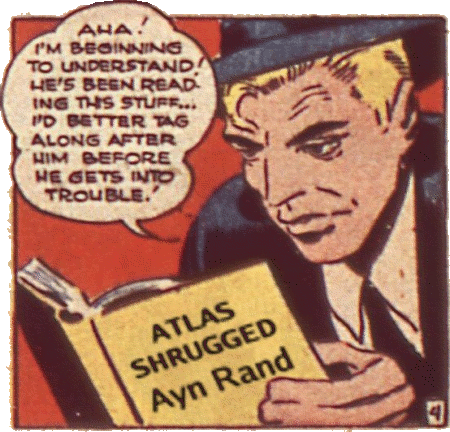
art by Morton Meskin

I believe that my first encounter with the works of Ayn Rand was in seeing as a child some of The Fountainhead (1949) on television. All that I really remember seeing of it then were the final two scenes, which may indeed be all that I saw. I would have been unable to tell anyone very much about the movie (I didn't even know its name), and unaware of there being a book whose ideas were behind it.

Later, I read some distinctive stories by Steve Ditko in Charlton Comics. I was not a fan of Ditko's graphic work (which combines spareness of detail with an a propensity to put figures in ape-like positions and to present an abundance of wildly exaggerated facial expression), but the stories were written from an unflinching, and seemingly grim yet ultimately optimistic belief in straight-forward good and beauty. I wouldn't have been able to tell anyone whose prior work had informed his.

My next encounter was as a teenager, in a Midwestern drug store. Some of Rand's books were in a rack there; on the backs of the volumes were remarkable claims about Rand's popularity and about her significance to many people. I was skeptical, as I'd not otherwise heard of her. In any event, I didn't buy any of the books, but a mental note was made.

When I became more politically active over the next few years, I began to encounter frequent reference to Rand from people with whom I had some ideological allegiance. So I decided to read one of her books.

I tend to read authors' works in the order in which they were written, and the earliest of Rand's works that I found when I looked at a book-store was The Fountainhead (1943); and I had begun to think that I'd seen part of a movie based upon it; so that was the book that I first read. It was rather a while before I read any more.

Reading The Fountainhead was not the transformative experience for me that it has been for some people. There weren't any notions in it that were new to me (albeït perhaps in part due to my prior exposure to Ditko), and Rand seemed to confuse egoism with egotism. In a preface, she blamed a use of egotism for egoism on a poor dictionary (English was not her first language), but it seemed and seems that the confusion at the time that she wrote that novel was not merely one of words but of ideas.

I think that Rand suffered from mind-blindness of a sort, such that she could not use ordinary intuïtions as most people do to understand other people. That is not to say that she could not use some other means; and being compelled to use other means sometimes even caused her to have insights that other people would miss. But it was a struggle, her understanding could be imperfect, and it left her treating empathy as if it were an unfair demand. (It surely didn't help that she'd been forced to live under a regime that willfully confused coërcive redistribution with brotherhood in order to license a considerable amount of repression and brutality.)

One sees this lack and rejection of empathy somewhat reflected through-out her writing. Its expression diminished over time, but at its worst it embraced sociopathy. In some of her journal notes of 1928, a young Ayn Rand seriously planned to have a hero modelled on William Edward Hickman, who in late 1927 had kidnapped a 12-year-old girl, and then delivered her grotesquely mutilated corpse when her father paid for her return. Hickman, as Rand saw him, had acted without concern for others, with the supposed motto What is good for me is right. In The Night of January 16th (1934), the protagonist is a woman whose heroic love is for a man whom she knows to be a conscienceless swindler (inspired by Ivar Kreuger). In We the Living (1936), the heroine at one point thrills in response to a depiction of a man whipping serfs, and her truest love, Leo, lives only for himself. In The Fountainhead, that has largely been left behind, but it has a very ugly echo.[1]

In The Fountainhead, the hero rapes the heroine. I put rapes in quotation marks because, even though it is called as much in the book, it (as Susan Brownmiller noted in an moment of lucidity) isn't a genuine rape; rather, it is a confrontation, pretty literally by engraved invitation, between two individuals over whether they will have sex on her terms or on his, which he wins largely by physical force. It was enough like a real rape that I was deeply appalled. Bearing in mind the historical context, that this was written in a time when rape was still widely romanticized, did not help much.

Thereäfter, the relationship between the two remains perverse, with the heroine marrying a couple of other men, whom she certainly does not love, simply to hurt the hero, whom she does love — in her own, Randian way.

Additionally, this was a book without much salvation. In particular, no one saves Catherine, a woman crushed by abandonment, who is then drawn into a life of soul-less self-lessness, and Gail Wynand's redemption is in suïcide. If anyone is actually saved in the book, it is Mallory, who fell so far as to have made a private attempt at popular sculpture, before Roark summons him to reälize his true vision. I would note that salvation was something that I had seen in at least one of Ditko's stories, in which the hero and heroine reach out to pull a fellow doing an imitation of Ellsworth Toohey (Rand's principal villain in The Fountainhead) back into a world-view of truly humanistic possibility.[2]

I finished reading The Fountainhead with little desire to read anything more by Rand.

But she continued to be referenced, positively and negatively, by friends and by allies, and I was ultimately moved to read her magnum opus, Atlas Shrugged (1957).

Atlas Shrugged was not so unpleasant as had been The Fountainhead. Rand again manages to toss her heroine into bed with two men other than the hero, the second much to the distress of the hero (and to that of some hapless other fellow), but this time she isn't out to cause anguish; she isn't even aware of him as a person. The descriptions of sex between the principal hero and heroine seem a little peculiar, but markèdly different from the confrontational initial sex of the previous book.

There's salvation of one sort in the book — the main hero is persuading the most genuinely productive members of society to withdraw, in order to bring an end to a social order of unreason that demands self-sacrifice and becomes ever-more totalitarian. But none of these people are in danger of being lost to the unreason itself. The two characters who are in such danger, Cherryl and Tony, are basically left by the heroes to sink or swim. Cherryl literally drowns, unable to cope (with no one helping her) when she begins to grasp the prevailing social order. Tony figures it out, with little help, and is shot dead for trying by himself to stop a group of thugs from the other side; by the time that a hero could be bothered to help him, Tony was really past help.

As well as the lack of empathy expressed in the treatment of such characters, there's something else that I take to be a manifestation of Rand's mind-blindness. Some of the villains demand to be understood; the heroes reject the idea that they must understand such people. And understand is the recurring word, without the heroes asserting that there is a difference between understanding and acceptance. Personally, I very much want to understand my opponents, without any expectation that this will cause me to think much better of them. In fact, having a working model of what makes them tick often intensifies my rejection, but it allows me to anticipate their behavior. However, Rand seems truly to object to a demand of understanding. I think that it was because understanding did not come intuïtively to her.

Atlas Shrugged is often criticized for the fact that its characters are archetypal, and apt to present long philosophical monologues in the context of extemporaneous discourse. I think that such criticism is actively ridiculous (especially when it comes from people who haven't directed the same criticism at the works of Shakespeare, or at various ostensibly classic works by Russian novelists,[3] whose characters are like-wise archetypal and like-wise given to unlikely speeches). Atlas Shrugged is a novel of archetypes and of monologues because it seeks to present a fairly comprehensive philosophical statement. Even with the device of archetypes and monologues, it is a very long book, and without those devices it would be less clear and probably much longer. It is also, somewhat more reasonably, criticized as belaboring ideas, but Rand was plainly concerned not to allow a point to be treated as obvious when presented and then repeatedly ignored in application; I think that such concern is quite well-founded.

As with The Fountainhead, reading Atlas Shrugged was not a transformative experience for me. There were only three philosophical novelties for me. The first was simply interesting; the second and third were not clear to me.

It used the word justice in reference to something inexorable. I'm not sure that I would use that term in that way, though it does seem useful to me to recognize that a natural law that says that one should or shouldn't do X is founded on one that says what obtains from doing X.

What I didn't understand, but wanted to pursue, were her claims about causality being necessitated by logic and that Logic is the art of non-contradictory identification.

I came away from Atlas Shrugged more willing to read other things by Rand, especially to understand what was meant by those last two assertions. The book in which the last was answered (she was cryptic on the other, and I had to figure that one out largely on my own) is also the book by Rand that most affected me philosophically, Introduction to Objectivist Epistemology (1979). I didn't agree with everything in it, and have since come to reject more in it than I did at first. I also came to recognize that a considerable amount of it is unacknowledgedly borrowed from Locke and from others. But I believe that there is a core to it that is an original synthesis and a genuine advancement in epistemology, more properly conceptualizing logic in terms of a Lockean notion of concepts.

As well as Introduction to Objectivist Epistemology, I got and read We the Living, Anthem (1938), various anthologies derived from The Objectivist Newsletter and from its successor, The Objectivist, and a few interviews. I also found and watched a movie whose screen-play she wrote, Love Letters (1945). (And, somewhere along the line, I watched the movie The Fountainhead from start to finish.)

In the fictional work, I perceived a recurring theme. As Rand herself essentially says in a later introduction, The Night of January 16th is about how Rand felt people ought to have reäcted to Ivar Kreuger's selfishness. Anthem is an unacknowledged re-write of We (1921), by Yevgeny Zamyatin; it is the novella that she thought that he ought to have written. I think that The Fountainhead is about the sort of man whom she felt Frank Lloyd Wright ought to have been. Love Letters is supposedly based on a book, Pity My Simplicity, by Christopher Massie, but when I skimmed through that I book, I found it hard to recognize the one in the other; meanwhile the screen-play bears a significant resemblance to Rostand's Cyrano De Bergerac, except that it ends with the true author of the love letters getting the girl; it is Rand again setting things as she feels that they ought to be. And Atlas Shrugged is, of course, about the strike that really ought to be held (and, on the side, with a pirate of the sort who ought to be out there plundering and sinking the ships that ought to be sunk). As to We the Living, well, I think that it's about the man whom Rand felt ought to have loved her.[4]

The non-fiction was often insightful or amusing; and, my objections to aspects of the sexuality in her novels not-withstanding, I also thought that some of the claims concerned love and sexuality were important insights. But, at some point, I just didn't think that I was likely to get much more value out of her work. Before Rand had died, I had stopped reading her work, except occasionally to read an excerpt here-or-there.

While she was alive, I didn't encounter many people who could admit both that Rand was right in some of her unpopular assertions and that she was wrong in others. Instead, the vast majority of people who recognized her name either denounced her as having had nothing to say that were both unusual and correct, or endorsed her every claim without exception, and each group was condescending and curtly dismissive of anyone who would say otherwise. (The preëmption, whatever its motive, insulated them from potential correction.) But, over time, I have increasingly noted people who self-identify with her philosophy, but not without their own criticism, and not without a willingness to entertain the thought that further criticism might be neither knavish nor foolish.

My own philosophical position is removed from Rand's in some very important ways, and I would simply not count myself as a subscriber.

For example, Rand treated existence as a property of things; I would join with various philosophers who would assert that existence is not a property of the thing considered, but of the consideration. When one says something such as that unicorns do not exist, one is really saying something about the idea of unicorns. (And to say that the idea of unicorns does exist is really to say something about the idea of the idea of unicorns, &c.) The reason that existence seems to be a property of things is that our natural discourse isn't clearly distinguishing between things and ideas of those things. If unicorns do not exist, then it is absurd to talk about the unicorn itself as having a property of non-existence, because there is nothing to have the property. Rand objected to Reification of the Zero, but if we treat existence as a property of elephants themselves, then its contradiction, non-existence, becomes a property, which can only be held by, um, nothing; the Zero would then be reïfied. Rand's formula existence exists isn't particularly helpful, and its invocation seems to be nothing more than an artefact of confusing a crudity of grammar with a metaphysical insight.

By the way, I want to mention a book by another author, The Watcher (1981) by Kay Nolte Smith. Smith was at one time amongst those personally associated with Rand, but (like many) eventually left. The Watcher is a novel that successfully fused much of what virtue is to be found in Randian fiction with a deep sense of empathy. And its heroes don't simply march relentlessly towards triumph, but reach back to save people who ought not to be lost.


[1] I wasn't at all positioned to write that paragraph until years after I read The Fountainhead.

[2] However, Ditko certainly does not present all of his characters as saveable; and, in particular, those characters of his who step across the line between Good and Evil with the thought that they will later redeem themselves are inevitably morally destroyed.

As to such crossings, Ditko's villains are more likely than those of Rand to be conscious of when they are crossing the line or that they have crossed the line. While both Rand and Ditko would declare wickedness to be founded in a choice not to think; Ditko's villains are more likely to be in fact thinking.

[3] It is certainly worth noting that Rand was a novelist from Russia.

[4] And thence I would explain much of the sexual dynamic across her fiction.

Baby Gays

Saturday, 2 January 2010

There's a fair amount of annoying absurdity associated with [remarkably realistic picture of cotton swab] the cotton swab.

The traditional use for these things is, of course, cleaning-out one's ear canal. Probably that's not a good idea, though. The back of the Q-tips® package at which I'm looking says

If used to clean ears, stroke swab gently around the outer surface of the ear, without entering the ear canal.

WARNING: Use only as directed. Entering the ear canal could cause injury. Keep out of reach of children.

(Emphasis theirs.) A swab could push cerumen (ear wax) deeper into the canal, and pack it more tightly. With or without the cerumen, the swab could be pressed hard enough to rupture the tympanic membrane (ear drum). And the swab might even promote infection.

But, though there may be some tiny number of people with such odd convolutions to their outer ears that a cotton swab would be helpful in cleaning them, most of the rest of us could get better or faster results with a cloth or tissue. If we're not going to put the swab in our ears, then it probably just shouldn't touch our ears at all. Granted that the box merely says If used to clean ears, but I remember a commercial from Cheesebrough-Ponds featuring Orson Bean, cleaning his outer ear with a Q-tip®, and advising us Never put anything in your ear, except your elbow. (Someone get that man a tissue.)

When doctors and medical advice columns tell their audience not to use these things in the ear, they frequently use a formula which gets my back up. Formally, it's Not-X. When X, then Y. which is to say that they claim something doesn't happen, and then tell us what to do when it happens. Jeez! More specifically, they tell us

The ear canal does not need to be cleaned, because it's a self-cleaning organ. […] When the ear canal needs to be cleaned, one should see a doctor.

Okay, the ear canal does need to be cleaned, because it is an imperfectly self-cleaning organ; let's not pretend otherwise while we're trying to keep the swabs out. And, as far as this see a doctor business, while it may seem like a mighty fine idea to the doctors, most people don't want to pay the cost of seeing a doctor. Even where medicine is socialized to the point that there would be no pecuniary cost in seeing a doctor, there will be the cost of waiting (which will typically be significantly higher where medicine is socialized). People want their ears unclogged quickly.

A better alternative to the swab for cleaning the ear canal is the syringe. For a few bucks, most druggists will sell you a syringe that's basically a rubber ball with a nozzle. If you went to the doctor, then he'd probably use a more impressive syringe, made of metal and with a plunger. You could order one of those for yourself for about US$20, but it's unlikely to be more useful for you unless you start syringing not only the ears of everyone in your household but also those of all your friends and neighbors.

If you read the instructions on the syringe package, it will basically tell you to dribble water into your ear. You will probably find this dribbling signally unhelpful unless you've used other fluid to dissove the cerumen and are now just rinsing the mess out. You can buy expensive fluids from your druggist, or you can use the dilute hydrogen peroxide that he'll sell you for much less, or you can use a mixture of vinegar and baking soda, each bought from the grocer. In all three cases, that's going to tickle maddeningly.

I once had my ear canals cleaned by a Doctor Villavecer, in Westerville, OH. He used one of those impressive metal syringes. He didn't dribble the water into my ear; he blasted it. That worked pretty well, though I might have felt differently had a tympanic membrane ruptured. In any case, subsequently, this blasting is how I clean my canals, except that I use a rubber ball syringe, as I am leaving the ears of my friends and neighbors clogged but unmolested.

Backing-up, let's return to the warning on that Q-tips® package:

Keep out of reach of children.

Now, unless we're prepared to tell people to keep lollipops and twigs out of reach of children, it doesn't make a whole lot of sense to put the Q-tips® with the pornography and assault rifles. We can instead tell junior not to put anything into his ear, and reälize that a swab would be less terrible in disobedience than many other candidates. I reälize that Cheesebrough-Ponds is not really to blame for this specific bit of nonsense (responsibility lies in the hands of lawyers, of state officials, and of the fools who empower them), but nonsense it is, none-the-less.

Lies, Damn'd Lies, Statistics, and…

Sunday, 29 November 2009

In my previous entry, I noted that, as the Gallup report of the President's approval rating approached 50% from above, there was an asymmetry in its perturbations, that it skated the 50% line, without blipping below it, for an extended interval. And I noted that, as the disapproval rating approached the approval rating from below, it tentatively seemed to be displaying a complementary asymmetry, plateauing when it might be expected to rise further.

Indeed, that reported plateau was stretched for a full week. If you'll look at the previous reported figures for the disapproval rating, you'll see nothing like it.

Perturbing

Tuesday, 24 November 2009

The news noted a few days ago that, according to the Gallup Organization, the approval rating for President Obama had fallen below 50%.

I've been watching the Gallup poll (along with other polls) for some time now, and had become increasingly doubtful of its reports. As the rating approached the 50% line, an apparent asymmetry developed in the perturbations, to which I refer as skating. This skating was at its most pronounced when the rating would hit the 50% line; it might blip up, but it would not blip down.

The Gallup Organization has referred to the President's drop below the 50% line as symbolic, but in a nation that likes its decisions made by majorities or by super-majorities, and with the President being of a party that named itself for democracy, having less than majority approval is more than merely symbolic.

The next milestone comes if-and-when the reported share of the population who disapprove of the President's performance exceed those who approve. The Gallup Organization has reported the disapproval rating being as high as 44%, and as generally climbing. But, guess what? For the last few days, even as the President's approval rating has been admitted to have dropped below 50%, the disapproval rating has been reported as plateauing, as if the loss of approval completely translated into indifference or indecision. Perhaps we are now going to see a sort of complementary asymmetry of reported perturbations for disapproval.

(The third milestone would be when the disapproval rating climbed above 50%.)

Comparatively Speaking

Friday, 20 November 2009

[This entry is based upon a reply to a friend, who requested an explanation of comparative advantage.]

Imagine that you and someone whom you know need each to produce reports that will involve both pages of text and pages of diagrams. Imagine further that you can produce ten pages of text in a day or five pages of diagrams in a day, while this other person can produce five pages of text or three pages of diagrams.

producerpgs txt / daypgs diag / day
you105
him53

You have an absolute advantage in the production of each good here. None-the-less, if you are able to trade (text for diagrams), both of you can gain.

For every page of diagrams that you produce, you have to forgo production of two pages of text. For every page of diagrams that the other person produces, he must forgo production of one and two-thirds pages of texts.

producerpgs txt / daypgs diag / daytxt / diagdiag / txt
you1052½
him531 2/33/5

Slow as he may be at each task, he has a comparative advantage in the production of diagrams. Setting aside transaction costs, if someone will trade text for diagrams at a ratio of better than five-to-three, then he can profitably make diagrams to trade for text. You, meanwhile, have a comparative advantage in the production of text. Setting aside transaction costs, if someone will trade diagrams for text at a ratio of better than one-to-two, then you can profitably make text to trade for diagrams. So trading at something between 1 2/3 pages of text and 2 pages of text per page of diagrams should work for you both.

The only way that each of two parties could not have a comparative advantage in something would be if everyone had exactly the same production trade-off ratios. That's not bloody likely.[1]

We certainly don't require that one party be worse at both things for each party to have a comparative advantage in something. Here

producerpgs txt / daypgs diag / daytxt / diagdiag / txt
you1052½
her565/61 1/5

each party has an absolute advantage in something, and a comparative advantage in that same thing. Such examples come freely to mind; and, because in such examples comparative advantage is in the same product as absolute advantage, such examples foster a confusion that absolute advantage determines where one should specialize or (worse) what one should produce. (The latter is worse because it mistakenly implies that one should never trade for something in which one has an absolute advantage.)

Comparative advantage underlies virtually all trade,[2] whether we're talking about two people or two firms or two nations. But it is in international trade that comparative advantage is most often discussed.

This attention is because lay-people are most likely to think that international trade or proper trade policy is instead somehow determined by absolute advantage. The fear that one country can somehow suck up everything through unregulated trade is almost always founded on a belief that absolute advantage (from cheap labor in the undeveloped world or from advanced technology in the developed world) determines who profits.

But explanations in terms of absolute advantage lack coherence. Returning to the original example of producing reports (where you have the absolute advantage in both products), there is no way for you to leave the other person worse-off through trade, unless he can be persuaded to trade at a ratio worse (inclusive of transaction costs) than he can produce for himself. Maybe he's dumb enough for that, but he could be dumb enough for that even if he had the absolute advantage in both.


[1] On the other hand, it is quite possible that the ratios could be close-enough that the costs of transaction (including transportation) could swamp-out the potential gains-from-trade.

[2] Off the top of my head, I doubt that there are actually any exceptions. For example, when one buys what may seem an over-priced product, as an act of pity or of charity, which product one could have produced for oneself, either the premium may be viewed as a purchase of something beyond the overt product, or the transaction may be decomposed into a trade coupled with a simple gift.

Unthwarted

Wednesday, 18 November 2009

I received notice this morning from eBay:

We received a report about a message you sent to another eBay member through our Email Forwarding System. The message violates the Misuse of eBay Email Forwarding System policy. We want to let you know about the report and invite you to learn more about communication between sellers and buyers. To learn more about the Email Forwarding System guidelines, please go to:

http://pages.ebay.com/help/policies/rfe-unwelcome-email-misuse.html

We're taking a neutral position regarding the report we received, but if we continue to receive similar reports, we'll have to investigate. Policy violations can result in a formal warning, a temporary suspension, or an indefinite suspension.

If you have concerns related to this matter, you can contact us by going to:

http://pages.ebay.com/help/contact_us/_base/index_selection.html

Well, I'd like to know about what message this complaint was levelled. But, naturally (this being eBay), there's no appropriate option at index_selection.html, and the best fitting options require that in one field I provide a relevant item number or user ID about whom I'm complaining. My own user ID is rejected from this field.

Over the years, eBay, like many other corporations, has modified its interface and protocols to make them dumber in ways that specifically increase the difficulty of confronting it with responsibility.

eBay was founded by Pierre Omidyar, whose user ID is pierre. So I entered that user ID in the field, and it was accepted. Doubtless that, if others do likewise, then the software will be tweaked to prevent it.

A Piece of Personal Philosophy

Friday, 13 November 2009

Don't eat anything that could have loved you.

The Story

Thursday, 29 October 2009

This video

has drawn a lot of attention on the Web. Here's an example of how the story is being covered by journalists:

Terrible parker in viral video charged from the Toronto Star
York Regional Police charged Tripta Kaushal, 62, on Wednesday with failing to remain at the scene of an accident. She is to appear in court Dec. 1.

But here's what I found when I poked-around:

In Remembrance of Shayam Kaushal, 1968 - 2009 by David Mandel at Canadian Mortgage Trends
Shayam is survived by his wife Anita, son Keshiv and daughter Karishma, and by his parents Amar and Tripta Kaushal, his brother Rajan, and his sister Kiran.

So here's how I read that video: Tripta Kaushal loved her son, as most mothers do. She lost him earlier this year, and it has been hard to cope. But she's trying to get on with her life, because, well, what else can she do? Part of trying to cope is exercise, so she's going to the gym. She's in the lot, trying to park her car. But even this is harder than it use to be, and she messes it up, terribly, unbelievably terribly. She literally drives onto a couple of cars. Not knowing what to do then, she backs off them. Then she sits in her vehicle, and starts crying. Because it's all too much. Not as bad as losing her Shayam, but another awful thing on top of losing him. And she knows that it's her fault, but she can't deal with it. So she drives away.

I'm not saying that what she did is anything but awful. She ruined people's cars, inflicting significant economic damage and damage that is less tangible but may none-the-less have been worse for the victims. She is responsible for this damage. But this is a video of a person who was and is held-together with the emotional equivalent of twine.

[Up-Date (2011:01/04): The YouTube account associated with the link to the video which I original used has been deleted, and with it the video. So I have linked to a different copy of the video.]

[Up-Date (2016:08/19): I notice that, once again, the video to which I linked was removed. So I have linked to yet a different copy.]

[Up-Date (2021:01/14): I have cloned the video to BitChute, so that Alphabet (Google) cannot use its IFRAME to track my visitors.]

Too Much

Sunday, 25 October 2009

As an economist, I am especially pleased and amused by the expression make oneself scarce.

Although scarce can mean no more than rare, its principal meaning is of being in insufficient quantity to exhaust desirable use, and it is in this sense that economists employ the term. Actually, something can be quite rare without our having any use for it, and something can be fairly abundant and yet be less than we could use.

A rational decision maker values a potential increase or decrease in the supply of something in terms of what use would be gained or lost. If a resource is not scarce, then it has no further use, and an increase would be valueless. And any decrease that didn't result in scarcity would also be valueless.

Thus, when someone is told Make yourself scarce!, the implication is that, at present levels, there is no further use for him or her; indeed, the suggestion is that there's just too much of him or her as it is. He or she is being told to reduce his or her presence until it has some g_dd_mn'd value.


It used to be fashionable in some quarters to claim that scarcity as economists understood it were a myth and that we lived in a post-scarcity economy. The essential claim there would be that we couldn't use any more of anything were it to become available. I regard that claim as offensively stupid. Not quite as dreadful were claims that we could soon have a post-scarcity economy. But the implication there would be that humans would be insufficiently clever to think of a further use for anything.

The people who made such assertions should have made themselves scarce.