Archive for the ‘ethics’ Category

Brushes with Dishonesty

Sunday, 22 March 2009

[Up-Date (2009:07/17): Some time after this entry was posted, CoolShaving.com removed its fraudulent claims, which had been up since at least 19 July 2006.]

At CoolShaving.com, they claim

Believe it or not, a young man actually thought we killed badgers to get these bristles for our shaving brushes. Nothing could be further from the truth. The manufacturer of these superior quality brushes maintains a flock of badgers that are more pampered and coddled than any badger in the wild, or any domestic animal for that matter.

The page on which they advertise the line of shave brushes doesn't identify the maker in text, but on the handles one can see that these brushes are branded Col. Ichabod Conk.

The Conk brushes are manufactured by Progress-Vulfix Ltd and by Dovo.

Progress-Vulfix Ltd makes no claims about a flock of badgers[1] nor of not using the bristles of killed badgers on the page where they describe their brushes at VulfixOldOriginal.com nor on that at Progress-Vulfix.com. Neither the string cruelty-free nor vegan are found at VulfixOldOriginal.com, nor at Progress-Vulfix.com

The brush that Dovo supplies to Conk isn't listed on the page of brushes sold by CoolShaving.com. But, for the record, the strings ohne Grausamkeit [without cruelty], Grausamkeit-frei, cruelty-free, and vegan do not appear at the Dovo site.

CoolShaving.com is registered to Jim H. Hedgepath of 129 Minnie Fallaw Road, Lexington, SC 29073-8226.


[1] A company of badgers is called a cete /sit/.

Hurrah!

Wednesday, 4 March 2009
Small Firm Attorney Gets Unprecedented Restitution for Child Porn Victim by Christian Nolan at Connecticut Law Tribune

When Stonington, Conn., resident and former Pfizer executive Alan J. Hesketh was convicted of distributing child pornography, the one punishment he probably didn't expect was paying restitution.

But in a decision drawing national attention, U.S. District Court Judge Warren W. Eginton for the District of Connecticut has ordered Hesketh to pay $200,000 to one of the girls, now 19, whose images Hesketh downloaded and distributed.

The Eco-Dupe's Shaving Kit

Sunday, 22 February 2009

In The Eco Gentleman's Shaving Kit: Back to Basics by Rob Knox at Greenopia, there is a reference to a shave brush made of cruelty-free badger hair, linked to a listing at drugstore.com for a shaving kit from Baxter of California, which listing describes the kit as Environmentally Friendly and Cruelty Free.

However, a Google search for cruelty free at baxterofcalifornia.com produces no hits, and Baxter's own description of their travel brush (in that kit), and that of their other shave brush simply don't report how the badger bristles are harvested. It is hardly plausible that Baxter of California would fail to mention that the badger were spared death or injury, as this would repel few-if-any customers, while attracting many of those who would otherwise purchase high-end synthetic brushes.

(Mr Knox also declares old [straight] razors from junk and antique shops are perfectly suitable once cleaned and sharpened, but this is only true in cases where the straight razors were of high quality before they got dirty and dull. There are plenty of new straight razors, such as those from Zeepk, which aren't suitable, because they are badly manufactured.)

on a wavelength far from home

Friday, 20 February 2009

There is a myth (demonstrated to be false by economist Ronald Harry Coase about 50 years ago) that, before the state stepped-in to regulate radio transmissions, there was simply chaos, as one would-be broadcaster tried to over-power the signal of another.

Actually, what happened was that broadcasters who wanted to work in the same frequency ranges and in the same geographical regions as each other went to court, and the courts began to apply the principles of homesteading to broadcasting. The main questions, as with the use of land, was of who was there first. Basically simple (though there certainly could be nuances).

Now, I would acknowledge the point, made by Donald Clayton Hubin and others, that allowing someone to own the use of one part of the electromagnetic spectrum doesn't seem different a priori from allowing them to own any other, and the intuitions of many of us would be immediately alarmed at the idea that someone should own, say, red in the Columbus PMSA. But we are alarmed in the context of there already being meaningful use of red by everybody; given that use of red, we could conceptualize the existence of easement of some sort actually giving us each a right to its continued use. On the other hand, prior to the development of radio, people did not so much use those parts of the electromagnetic spectrum as accidentally generate such electromagnetic radiation. For important parts of the spectrum, that remains the case. And, in-so-far as such accidental generation may be long-standing and so forth, one could believe that there was an easement allowing such continued accidents, but otherwise impute a property right to broadcasters in the same ranges as the accidents.

There's also a bit of apparent oddness in the fact that broadcasting amounts to vibrating the surrounding area; this seems a use of the properties in the surrounding area. But, while it's certainly a use, we have to be careful about the issue of whether it is a use of the property of others. We tend to equate property with the object against which a property claim is made. For example, we would normally simply say that Thomas's house is Thomas's property; we would even normally continue to say this if Thomas rented the house to Richard. But the notion of property rights as distinct from use rights is incoherent, and the rental agreement transfers some of Thomas's property rights to Richard, even if only rights specific to a defined interval. So, backing-up, we need to at least ask whether the property rights of those otherwise owning physical things in the area surrounding a broadcaster included exclusive rights to vibrate those things, or at least exclusive rights to vibrate them other than in the aforementioned accidental manner.

The reason that the airwaves were declared to be public was not because there was no coherent model of private property in the use of the electromagnetic spectrum, and the declaration certainly wasn't to end chaos.

(Nor was it because there is a natural monopoly of some sort in broadcasting. Consider how few daily newspapers the typical city now has, as opposed to how many radio and television stations it has.)

The nationalization of radio broadcasting was to introduce censorship. People were broadcasting opinions that the state and its clients didn't want broadcast, such as attacks on the medical profession. Freedom of speech was the chaos that was stopped.

This brings me to the Fairness Doctrine, which was introduced in 1949 and prevailed until late-mid 1987. The doctrine ostensibly required broadcasters to present opposing views on important and controversial matters, in a fair and balanced manner.

Even if it had done this much, it would have been a gross violation of freedom of expression, much like forceably demanding that any of you reading this entry both speak-out on important and controversial issues and that you always defend, as strongly as practicable, views that you oppose. Operationally, you couldn't be a spokesperson for your own views so much as a reporter of what views were had.

But, in practice, the Fairness Doctrine was part of a system of disguising gross biases as balance. For example, the gentlemen's agreement (sans gentlemen) between the prevailing political left and political right has been that only both sides are represented, not the views of those who do not fit on whatever might be the left-right spectrum of the day, the Fairness Doctrine abetted the impression that no one (or no one who mattered) could have such views. Beyond this, the politicial left, for most of this period, was largely successful both in disguising their own views as neutral, and (when unable to do that) in selecting poor representatives of the political right to present opposing views; thus not even both sides were given the same opportunity to be heard.

The Doctrine fell because of pressure from those who opposed censorship in principle and from those who were given the short end of the stick (the political right) or given pretty much no end of the stick (everyone not on the left-right spectrum).

Once the Doctrine fell, the political right developed a counter-weight of a sort to the main-stream media. Against CBS, ABC, NBC, PBS, and NPR, the right threw-up first a network of AM radio stations and then Fox Television. In terms of combined listenership and viewership, these countervailing broadcasters don't match the old main-stream, but it upsets the political left that there should be grossly biased broadcasting, when the gross bias isn't their own. And, in spite of their continued dominance in the more important medium of broadcast television, it hugely disturbs the political left that the right-wing has a larger presence in AM radio.

Parts of the left persuaded themselves that the right-wing dominated talk radio because powerful corporations were willing to sacrifice direct profitability in order to mold public opinion in favor of the political right, and therefore presented only personalities such as Rush Limbaugh, rather than what would be popular progressive (social democratic) personalities. Hence, Air America Media. But, in operation, Air America has not been profitable; it has been a meaner, dumber NPR, dependent upon subsidies.

So there has been increased interest on the part of the left-wing in a revived Fairness Doctrine. And even trial balloons about somehow applying it to the Internet. Therefore, I am pleased and relieved that the Obama Administration has declared that it does not support a revival of the Doctrine. I would really like to believe that this decision is based on a respect for freedom of speech, but the plain fact is that the present SCotUS has a majority bloc that could be expected to reject a Fairness Doctrine as unconstitutional, and the Court could well continue to have such a majority for at least the next eight years. (Justices Kennedy and Scalia are each about sixteen years younger than Justice Stevens.) But if just one member of that bloc were to leave the court then the Obama Administration would be faced with a new calculation.

What Else Is New?

Tuesday, 17 February 2009

As is its wont, the Beeb gets things quite wrong:

Race for God particle heats up by James Morgan of the BBC
Fermilab say the odds of their Tevatron accelerator finding it first are now 50-50 at worst, and up to 96% at best.

Cern's Lyn Evans admitted the accident which will halt the $7bn Large Hadron Collider until September may cost them one of the biggest prizes in physics.

The race hasn't heated-up; it has slowed-down as a result of the CERN accident, giving Fermilab a chance to catch-up and possibly win.

Speaking of the Beeb getting things wrong (this time for lack of ethical bearings), here's and interesting (if somewhat lengthy) critique of Earth: The Climate Wars:

Brush with Destiny

Tuesday, 20 January 2009

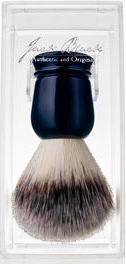
This morning, I tried a Jack Black® Pure Performance Shave Brush. Its bristles are synthetic (the badger lives to see another day) and anti-microbial, but designed to perform like a silver tip badger brush (which is generally held to be the best sort).

I have a Burma Shave™ boar-bristle brush that I got before I learned that boars were killed for the bristles, and an Art of Shaving® basic badger-bristle brush given to me as a gift before the giver learned that badgers were killed for the bristles. Jointly, these could last quite a few years. But I was quite interested to try a synthetic brush, partly so that I would know whether they were good gifts, and partly so that I could write and speak about them from experience.

The thing that I always read about most synthetics is that that they don't hold water as well as do natural bristle brushes. Well, I've not yet done a head-to-head comparison with anything but the boar-bristle brush, but the Black® brush definitely holds considerably more water than does a Burma Shave™ boar-bristle brush. (So much so, in fact, that I ended-up with far more dilute lather than I wanted. That's a problem that I can easily address, by just shaking out the brush before I put it in the soap.)

The Black® brush also feels much nicer against my skin than does the boar-bristle brush, and certainly nicer than did the boar-bristle brush when it was new. And the boar-bristle brush smelled like a musky animal when it was new, whereäs the Black® brush naturally didn't. (Jack Black in fact gave it some sort of pleasant scent which I presume will wash away with use.)

I will probably, at some future point, try the genuine badger brush that I was given. The badger whence the bristles came isn't going to get any more killed; and, while I wouldn't thus have tested the Black® brush against a high-end badger brush, I would at least have tested it against a badger brush of some sort.


While I am on the subject of shave brushes, I would like to mention the Burt's Bees® Natural Bristle Shaving Brush, found in their Bay Rum Men's Shaving Kit and sometimes sold separately. A little research confimed my suspicion that the bristles are boar bristles.

Burt's Bees proclaims

our goal is to help create a world where people have the information and tools they need to make the highest ethical choices

Now, reasonable people might argue over whether it's ethical to kill animals for shaving products, but one doesn't have the information needed to make the highest ethical choices if one isn't being told that these natural bristles were harvested from killed boars; plainly a significant share of Burt's Bees' customers would have concluded that the use of such bristles were unethical. And we may safely presume that the boars were killed (though there is a ranch in Spain that would happily sell them bristles sheared from boars who are not killed), because Burt's Bees, which makes a point of telling us that it doesn't engage in animal testing hasn't made a point of telling us that these bristles were sheared from live boars.

Possibly Burt's Bees just didn't know any better (much as I didn't know any better). I notice that the Bay Rum Men's Shaving Kit is presently listed as currently out of stock, and I can't find the brush itself listed separately at their site (though I can find it sold by Red Rain, a company that claims to offer the concientious consumer earth friendly, cruelty free products and services). But Burt's Bees has grossly failed its customers, either willfully or inadvertantly, and owes to them an explanation and an apology.

Bladder Control Problem

Monday, 10 November 2008
Jersey City Councilman Steven Lipski is No. 1 threat at Washington club by Richard Shapiro of the New York Daily News
A drunken Jersey City councilman was arrested for urinating on a crowd of concertgoers from the balcony of a Washington nightclub, police and club sources said Saturday.

And, since the Councilman's party affiliation is mysteriously not given in the story, one might google

"Steve Lipski" (democrat | democratic | republican)

This time, I was amused to find that many of the first hits are exactly about the failure to report his party affiliation. I was also amused to find his declaration

Yes, I am a Democrat, but I have always put people before politics.

as urinating on the crowd suggests that he puts some peculiar things well ahead both of people and of politics.

Call it treason

Saturday, 11 October 2008

Some people are taken aback at how I use the word treason in a political context. So let me explain. Here's the first definition of treason that one finds in the American Heritage Dictionary:

Violation of allegiance toward one's country or sovereign, especially the betrayal of one's country by waging war against it or by consciously and purposely acting to aid its enemies.

Note that the betrayal is of the country or of the sovereign, not of the state. As to the sovereign, in a republic, supreme power lies in a body of citizens who are entitled to vote for officers and representatives responsible to them; in a liberal republic, a fair amount of that supreme power is individualistic (rather than collectivist) in nature.

I'm just speaking goddamn'd English when I refer to violations of individual rights by state officials as treason.

With that in mind, I note some treason to which the Woman of Interest draws my attention:

U.S. tapped intimate calls from Americans overseas, 2 eavesdroppers say by George Miller of the Los Angeles Times
The linguists said that recordings of intimate conversations between citizens and their loved ones were sometimes passed around, out of prurient interest, among analysts at an electronic surveillance facility at Ft. Gordon, Ga.

I always assumed that my conversations with my ex-girlfriend while she was in Iraq were recorded. I wasn't particularly disturbed by that thought; one end of that conversation was in a fr_ggin' war zone. And I didn't have anything to say to her that would be of prurient interest anyway, unless the listener were quite oddly perverse.

But none of these personal conversations should have been circulated for purposes of entertainment, even in cases where the discourse weren't potentially embarassing.

And, when the next President fails to bring these analysts up on charges of treason, that failure will itself be treason.

Brushes with Death

Thursday, 31 July 2008

As a result of contemplating eventual replacement of my shaving brush, I have been looking into how three sorts of animal hair are harvested — badger, boar, and horse.

A type of badger bristle is used for the finest sorts of shaving brushes, but these bristles are got from killed badgers. As much as I would like a high-quality shaving brush, I do not want to do anything to promote the killing of badgers. (Their populations could be controlled without slaughter.)

Other shaving brushes (like some hair brushes) are made with boar bristles. Most boar bristles seem to come from killed boars, but there is actually at least one firm that shears living boars to harvest their bristles. I'll look into brushes from such a source.

(I can also get a synthetic-bristle shaving brush, though by all accounts these are inferior to natural-bristle brushes.)

I was under the impression that some shave brushes were made with horse hair, but seem to have been mistaken on that score. [Up-Date (2 August): I have indeed found some horse-hair shaving brushes.] In any event, I learned that some horses are raised for the hair of their manes or tails, which is clipped, but that most horse hair comes from slaughtered horses.

Kamchatka Kryptonite

Friday, 20 June 2008

BTW, a couple fo days ago I posted yet another poll at my 'blog. This time, it's not quite a matter of a dollar having fallen on the floor….